
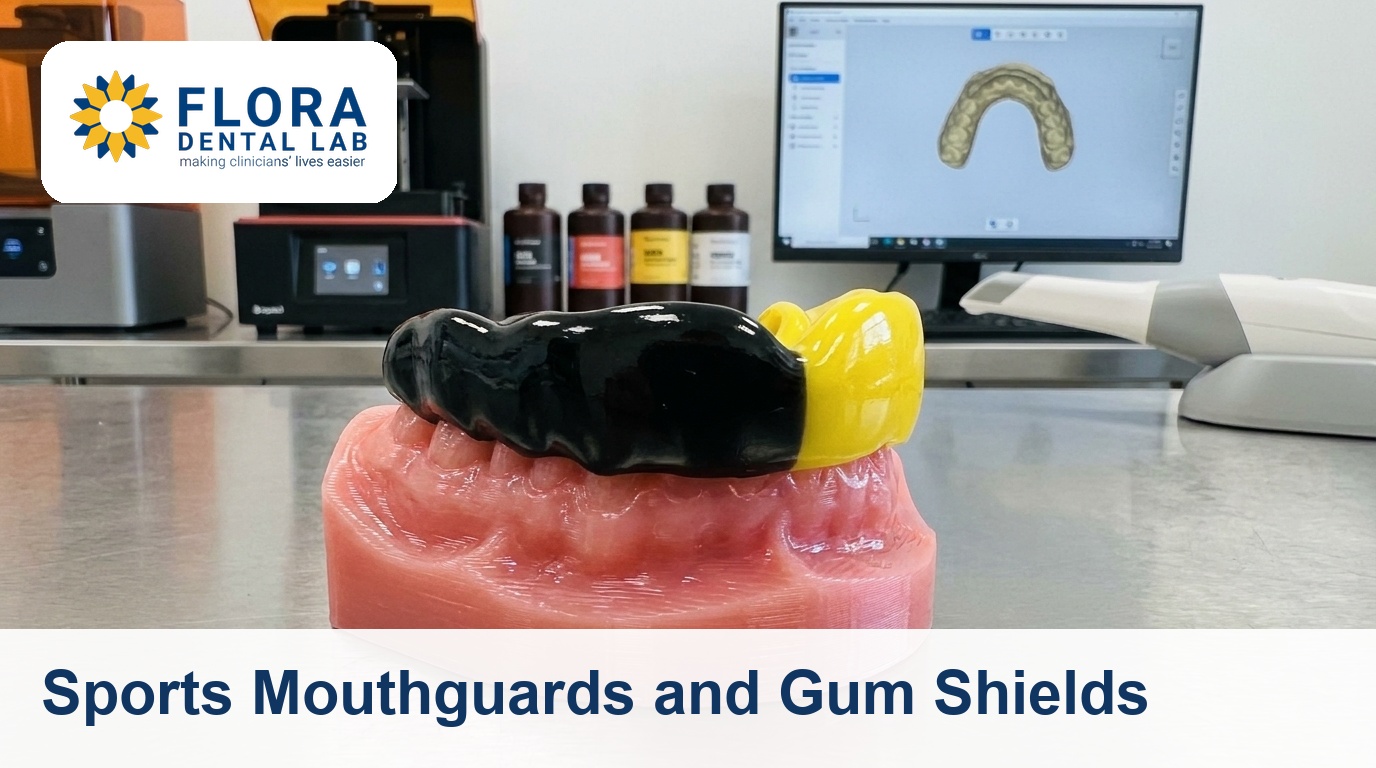
A sports mouthguard, or gum shield, is a custom lab-made appliance that absorbs and spreads impact to protect a patient’s teeth, lips and jaw during contact sport. This guide covers how a lab guard differs from a boil-and-bite, the protection levels we build per sport, and what to send us.
Your patients can buy a boil-and-bite gum shield from any high street sports shop, so the question they bring to your chair is whether a custom guard is worth it. For any patient in regular contact sport, the answer is yes, and a properly retained custom guard also protects fixed appliances and recent restorative work. If you also make appliances for grinding, see our guide to night guards and splints.
Custom Lab Guard vs Boil-and-Bite
A boil-and-bite mouth guard for sports is a thermoplastic blank the patient softens in hot water and bites into at home. It is cheap and available everywhere, but it thins out unevenly over the biting surfaces, loses adaptation after a few wears, and relies on a clench to stay in. A custom mouthguard is fabricated over a model of the patient’s own arch, so wall thickness is controlled, retention comes from the fit rather than from biting down, and the guard stays seated when the patient talks, breathes and takes a hit.
- Fit: the custom guard is formed on the patient’s model, so it seats on the teeth and stays put without clenching.
- Thickness: we control occlusal and labial thickness across the arch; a boil-and-bite thins wherever the patient bit hardest.
- Retention: a lab guard grips the undercuts and survey line, so it does not get spat out or chewed loose mid-game.
- Lifespan: EVA holds its form far longer than a remoulded blank that softens again on a warm day.
In short, the boil-and-bite protects on day one and degrades from there; the custom guard holds its protection for the life of the appliance.
What a Gum Shield Is Actually Protecting
A gum shield is named for the gums, but the job is wider than that. The guard has to absorb a direct blow, spread the load away from any single tooth, cushion the lips and cheeks against the teeth, and help separate the arches so the mandible is not driven straight into the maxilla. That is why thickness and coverage matter more than colour or branding.
- Teeth: it stops fracture, avulsion and intrusion of the anterior teeth, which take most sports impacts.
- Soft tissue: it shields the lips and inner cheeks from being cut against the incisal edges.
- Jaw and joint: occlusal coverage cushions the bite and reduces force transmitted to the TMJ and skull on a chin strike.
- Restorations: it protects crowns, bridges, veneers and recently placed implants from a knock that would otherwise mean a remake.
Protection Levels and Sport Type
There is no single right thickness. We match the build to the sport, because a guard heavy enough for boxing is needlessly bulky for non-contact training, and a thin guard fine for netball will not survive rugby. Tell us the sport on the prescription and we set the EVA accordingly.
- Light contact: basketball, netball, skateboarding. A single-layer guard around 2 to 3 mm over the labial surfaces is usually enough.
- Medium contact: hockey, football, martial arts training. A heavier single or dual-layer build, typically 3 to 4 mm labially.
- Heavy contact: rugby, boxing, MMA. A laminated multi-layer guard with a hard insert option, built up over the incisal edges for maximum impact spread.
We laminate pressure-formed EVA sheets rather than vacuum-forming a single blank, which gives a denser, more uniform wall and lets us add a shock-absorbing layer where the front teeth need it most.
Material and Construction
Sports guards are made from ethylene-vinyl acetate (EVA), the same family of thermoplastic used for many clear aligners and soft splints, chosen because it cushions on impact and is comfortable against soft tissue. The difference between a cheap guard and a protective one is how that EVA is laid down.
- Material: medical-grade EVA, pressure-laminated for a dense, even wall rather than a thinned vacuum-formed shell.
- Layers: single layer for light contact, dual or multi-layer with a harder insert for heavy contact.
- Coverage: full labial coverage to the vestibule, occlusal coverage of the posterior teeth, and a smooth palatal border that does not trigger a gag.
- Finish: rounded, polished edges so the guard does not abrade the lip or cheek, in the patient’s choice of colour.
EVA is a soft, cushioning material, which is the opposite of the hard acrylic we use for a grinding splint. The two appliances are not interchangeable.
Mouthguards for Patients in Braces
An orthodontic patient in contact sport needs a guard, but a standard custom mouthguard moulded tight to the teeth will not fit once the brackets are on and will fight every tooth movement. For patients in fixed appliances we make a guard with extra clearance over the labial surfaces, so it accommodates the brackets and archwire and tolerates the teeth shifting underneath it.
- Bracket clearance: the labial wall is blocked out to sit over the appliance without locking onto it.
- Top and bottom: many orthodontic patients want a gum shield for braces top and bottom, since a chin strike can drive lower brackets into the lip; tell us if you want a dual-arch guard.
- Refit: as the teeth move the fit loosens, so an orthodontic guard is a shorter-life appliance than a guard on a settled arch.
We need a current scan or impression taken with the appliance in place, not a pre-treatment model, or the guard will not seat.
Sizing Across Age Groups
Most sports guards are made for a child or teenager, because that is when contact sport and a still-developing dentition overlap. A child mouth guard for sports cannot simply be a scaled-down adult guard, because the arch is mid-eruption and the fit will not last a season.
- Mixed dentition: where teeth are still erupting we leave eruption clearance so the guard does not block teeth coming through.
- Growth: a child’s guard has a shorter useful life and should be rescanned when the dentition changes noticeably.
- Adult arch: a settled adult dentition takes a tighter fit and a heavier build for the same sport.
For a fast-growing patient, plan on a refit per season rather than expecting one guard to last for years.
Sports Guard vs Night Guard: Not the Same Appliance
Patients and reception staff use mouthguard, gum shield and night guard interchangeably, but they are different appliances for different jobs. A sports guard is a soft EVA guard that absorbs sudden external impact. A night guard, or occlusal splint, manages the slow, repeated load of bruxism and is usually a harder material. A soft sports guard worn for grinding can make clenching worse, and a hard splint offers no impact protection on the pitch.
If a patient is asking about grinding rather than sport, that is a different prescription. See our guide to soft versus hard night guards for the soft versus hard decision.
Sending a Case to Flora
We fabricate sports mouthguards from a digital scan or a physical impression of the arch. A scan is cleaner for a soft-tissue-bordered appliance like this, and we accept files from 3Shape, Medit, iTero and Dexis. On the prescription, tell us the sport and contact level, whether the patient is in fixed appliances, single or dual arch, and the colour.
- Scan or impression: a full-arch scan of the working arch, or a well-extended alginate or PVS impression captured to the vestibule.
- Prescription detail: sport, contact level, braces or not, single or dual arch, and colour choice.
- Turnaround: a sports guard runs on our standard lab schedule of roughly 10 working days; flag genuinely urgent fixture dates so we can plan.
- Accreditation: Flora is DAMAS, DLA and GDC accredited, so the appliance and its materials are fully traceable.
If you have not sent us a case before, your first one is free up to £100, with no invoice and no contract, so you can judge the fit and finish on a real patient before you commit.
What is the best type of mouthguard for sports?
A custom lab-made guard, fabricated over a model of the patient’s own arch. It controls wall thickness, retains without clenching and holds its protection far longer than a boil-and-bite, which thins unevenly and loosens after a few wears. For any patient in regular contact sport it is the guard worth prescribing.
What is the difference between a sports guard and a mouth guard?
They are the same thing. Sports guard, mouth guard and gum shield all describe a soft EVA appliance worn to protect the teeth and jaw during sport. The term to keep separate is night guard or occlusal splint, which manages grinding and is a different, usually harder, appliance.
How do custom mouthguards compare to boil-and-bite?
A custom guard is formed on the patient’s model, so thickness is controlled, it grips the teeth rather than relying on a clench, and it keeps its shape for the life of the appliance. A boil-and-bite thins wherever the patient bit hardest, loosens with each remould and degrades on a warm day. The custom guard protects more and stays put.
Will a mouth guard help TMJ?
A sports mouthguard is not a TMJ appliance. Its occlusal coverage does cushion the bite on impact, but managing TMJ pain or bruxism is the job of an occlusal splint, not a soft EVA sports guard. Worn for grinding, a soft guard can actually increase clenching. For those patients prescribe a night guard instead. night guards and splints
What is a sports mouthguard called?
A sports mouthguard goes by several names, including gum shield, mouth protector, mouth guard and gumguard. They all describe the same soft impact-absorbing appliance. Only night guard, occlusal splint and bite splint refer to a different, grinding-focused appliance.
How do I clean and store a sports mouthguard?
Rinse it in cold water after every use, brush it gently and store it dry in a ventilated case, never in hot water or a hot car, which warps the EVA. We cover the full routine in our care guide. mouthguard cleaning and care guide
