
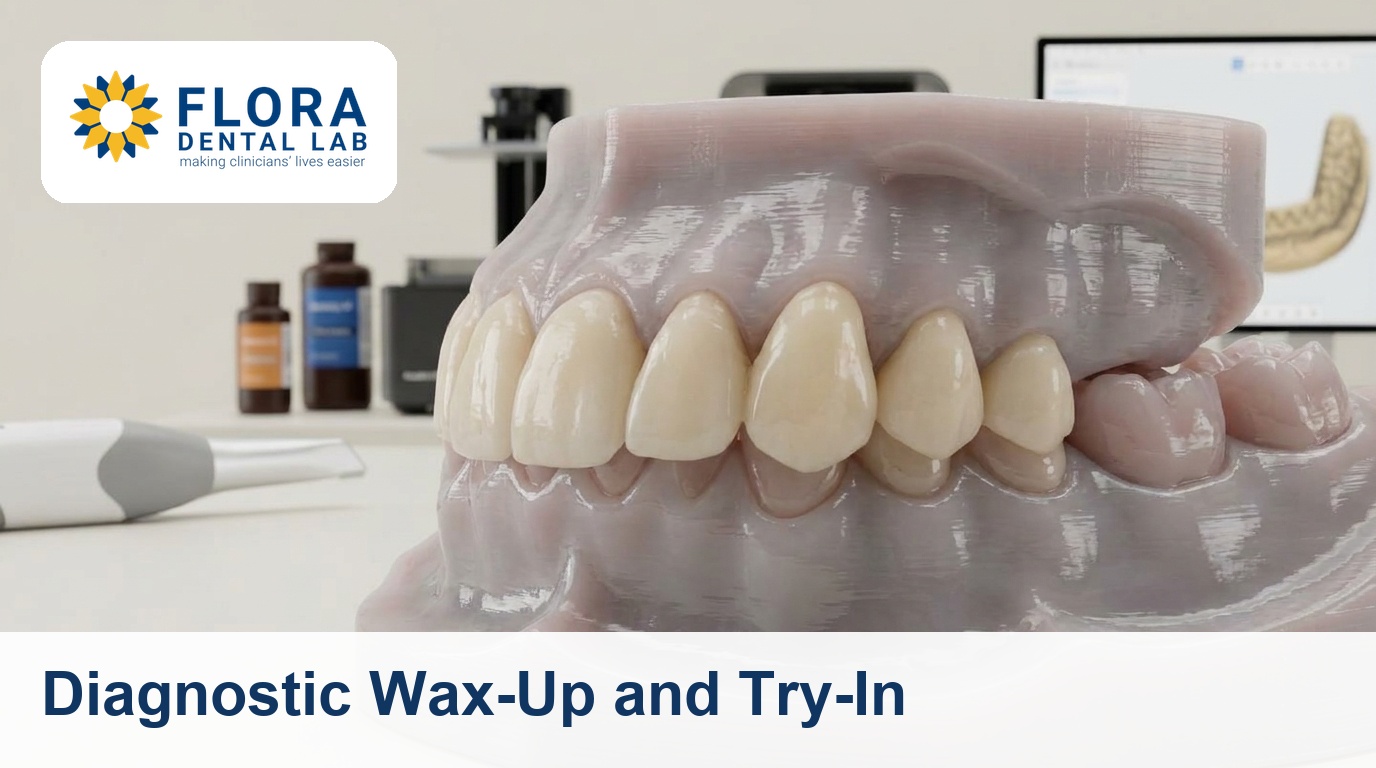
A dental diagnostic wax up is a 3D blueprint of the planned result, built in wax or digitally on a model of the case before any irreversible work begins. Here is how we approach it at the lab.
A diagnostic wax-up is where most restorative and aesthetic cases should start. It turns a treatment idea into something you, the patient, and the lab can all see and agree on before a single tooth is prepared. The same model then drives the preparation guides, the temporaries, and the final restorations. If you scan rather than impress, our digital dental lab workflow covers the inputs we work from.
What a Diagnostic Wax-Up Actually Is
A diagnostic wax-up is a wax model of the proposed final restorations, built on a duplicate cast of the patient’s teeth. It represents the desired shape, length, contour, and occlusion of the planned crowns, veneers, or bridges before treatment starts. The term diagnostic wax up and the shorter wax up both describe the same outcome-based planning tool.
Because it is an outcome-based tool, the wax-up has to represent the intended final result as accurately as possible. It is not a rough sketch. It is the reference the whole case is then built against.
- Visualisation: the patient and the dentist see the planned result in three dimensions, not as a verbal description.
- Communication: it aligns the dentist, the lab, and the patient on one agreed design before anyone commits.
- Fabrication driver: the same wax-up produces reduction guides, silicone indices, temporaries, and the final restorations.
When to Request a Wax-Up From the Lab
Not every single crown needs one. A wax-up earns its place as soon as the case involves changing the existing shape, length, or position of teeth, or as soon as more than one or two units are involved. The more the patient is being asked to imagine, the more a wax-up does for you.
- Anterior aesthetics: veneers and smile design, where length, midline, and incisal edge position all change.
- Multiple units: several crowns or a bridge where contour and contact points have to be planned together.
- Full-mouth and rehabilitation: cases that rebuild worn or collapsed dentitions across both arches.
- Occlusal changes: anything that alters the vertical dimension or the occlusal scheme.
- Implant-supported work: where the wax-up confirms tooth position before the restorative and surgical plan is locked in.
If you are unsure whether a case warrants one, send us the inputs and tell us the goal. We would rather flag that a wax-up is worth it up front than rework a finished case later.
Digital Versus Hand Wax-Up
Both routes produce the same thing: a 3D blueprint of the planned restorations. The difference is in how the design is built and how easily it can be revised. We choose based on the case and on what you send us.
- Hand wax-up: a technician adds wax to a stone cast mounted on an articulator. It gives genuine tactile control over contour and morphology and reads very naturally in the mouth.
- Digital wax-up: the design is sculpted in CAD from an intraoral scan or a scanned model. It is fast to revise, easy to mirror and copy, and feeds straight into milling and 3D printing.
For our CAD-driven design and how a digital wax-up flows into milling and printing, see our guide to CAD/CAM fabrication.
Neither approach is universally better. A digital wax-up is ideal when you expect several rounds of revision; a hand wax-up still wins for some complex anterior morphology.
From Wax-Up to Mock-Up and Temporaries
The wax-up is the design. The mock-up is that design transferred into the patient’s mouth so it can be tried in. This is the step that turns a model the patient looks at into something they wear and approve, and it is why mock up dentistry sits at the centre of any predictable aesthetic case.
- Silicone index: we make a putty or silicone key off the approved wax-up. That key carries the exact wax-up shape.
- Intraoral mock-up: you load the index with a bis-acryl material and seat it over the unprepared teeth, giving a direct preview in the mouth with no irreversible work.
- Temporaries: the same index makes provisional restorations after preparation, so the patient leaves in the agreed shape.
The mock-up is also a test drive of function and phonetics, not just looks. If the patient asks for the edges shortened or the smile widened, that feedback goes back into the wax-up before the final restorations are made.
Wax-Up Versus Mock-Up: The Difference
These two terms get used interchangeably, but they are not the same thing, and the distinction matters when you brief the lab. A wax up try in conversation usually means moving from one to the other.
- Wax-up: the design built on a model, off the mouth. It lives in the lab and is what we revise.
- Mock-up: that design transferred into the patient’s mouth via an index, so it can be seen, felt, and tried in chairside.
Put simply: the wax-up is the plan, the mock-up is the rehearsal. The final restorations are only made once the mock-up has been approved.
What the Lab Needs From You
The wax-up is only as good as the inputs. A vague brief produces a generic result that the patient may not recognise as their own smile. The more context you give us, the closer the first version lands.
- Accurate impressions or scans: full-arch records of both arches plus a bite registration. We accept files from 3Shape, Medit, iTero, and Dexis scanners.
- Photographs: retracted and natural smile views, plus a frontal portrait. These tell us about lip line, midline, and how much tooth shows.
- The aesthetic goal: tell us what the patient wants changed, length, shade direction, the level of dominance, and any reference smile they have shown you.
- Functional notes: any parafunction, existing wear, or vertical dimension changes you are planning.
- Shade and contour preferences: if you have a target shade or want a more conservative or more characterised result, say so up front.
If you are still working out impression and tray choices for accurate records, our guide to dental impressions and trays covers what gives us a clean model to wax against.
How the Wax-Up Carries Into the Final Restorations
The point of all this planning is that nothing gets lost between the agreed design and the definitive work. Once the wax-up and mock-up are approved, that exact geometry drives the rest of the case.
- Reduction guides: made off the wax-up so you remove the right amount of tooth in the right places, no more.
- Provisional matrices: temporaries that match the approved shape, so the patient previews the result through healing.
- Final fabrication: the approved contours carry through to the definitive crowns, veneers, or bridge.
For how that approved design becomes the finished units, see our crown and bridge service.
Sending a Wax-Up Case to Flora
Flora Dental Lab is a UK lab working with UK practices, accredited with DAMAS, DLA, and the GDC. Send us your impressions or scans, your photographs, and a short note on the aesthetic goal, and we will return a wax-up for your approval before anything goes definitive.
We offer your first case free, up to £100, with no invoice and no contract, so you can judge the planning and the workmanship on a real case before you commit. Turnaround for crown and bridge work runs to around 10 working days, and we will scope wax-up timing with you when you send the case.
Send us the case and the goal. We will tell you honestly whether a wax-up is worth it and what we need to get it right the first time.
What is a diagnostic wax-up in dentistry?
It is a wax model of the planned final restorations, built on a cast of the patient’s teeth. It provides a blueprint of the final result and is used to make putty keys for temporaries and reduction guides for tooth preparation, all before any irreversible work begins.
What’s the difference between a wax-up and a mock-up?
The wax-up is the design built on a model in the lab. The mock-up is that same design transferred into the patient’s mouth using a silicone index, so it can be tried in and approved chairside. The wax-up is the plan; the mock-up is the rehearsal.
What does a dental wax-up look like?
It is a three-dimensional model of the mouth, taken from impressions or a scan, so it is an accurate replica of the patient’s teeth with the proposed restorations sculpted in wax. It lets the dentist see what is required and how the finished case will look.
Can a diagnostic wax-up help with veneers?
Yes. Veneer and smile-design cases are where a wax-up does the most work, because length, midline, and incisal edge position all change. The wax-up becomes a mock-up the patient can try in, then drives the reduction guides and the final units.
How long does a diagnostic wax-up take?
It depends on the number of units and the complexity, and on how many rounds of revision the case needs. Digital wax-ups are quicker to revise. Send us the case and the goal and we will scope timing with you alongside our usual crown and bridge turnaround of around 10 working days.
What does the lab need to make a good wax-up?
Accurate full-arch impressions or scans of both arches with a bite registration, clinical photographs showing lip line and midline, and a clear note on the aesthetic goal. Good records and a clear brief are what let the first version land close. See our guide to impressions and trays.
