
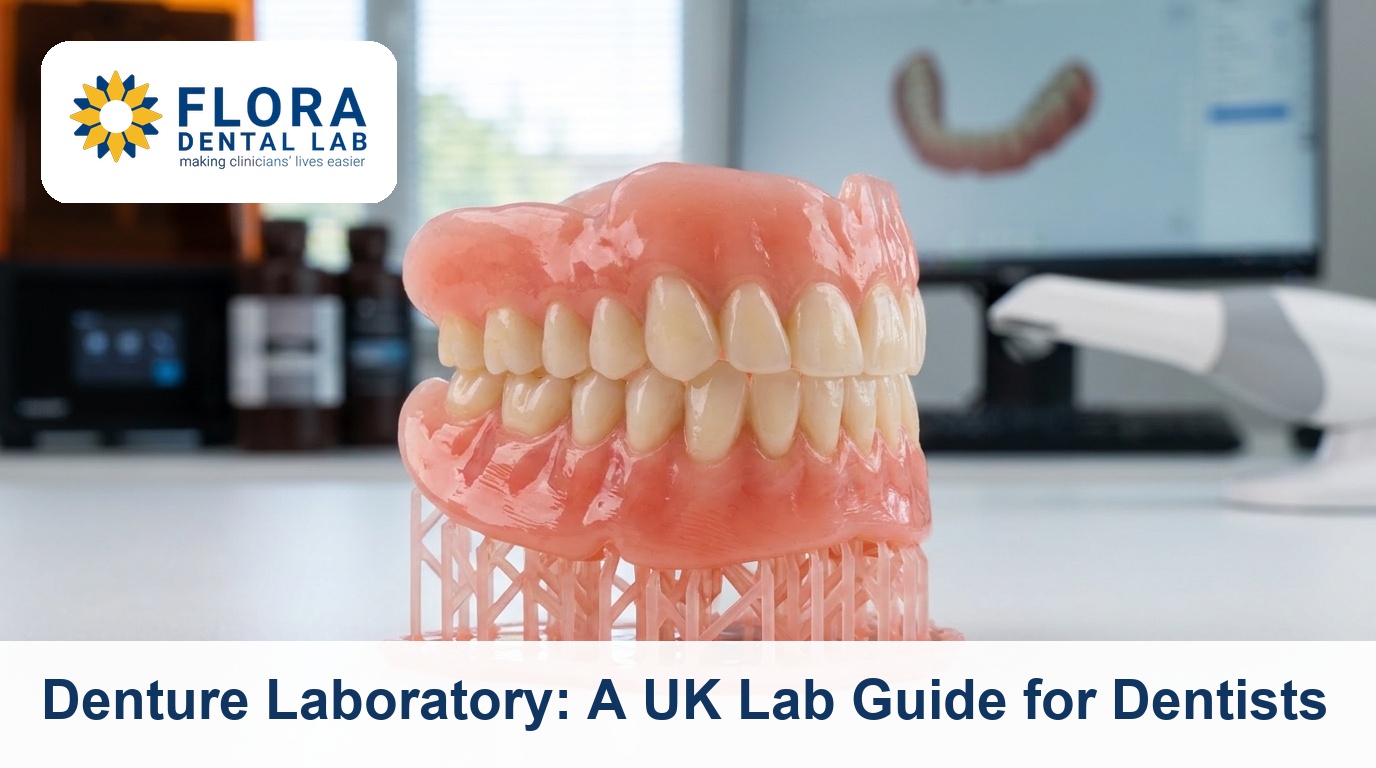
This UK denture laboratory guide covers what a lab does for your practice: takes your impressions, scans and prescription, and fabricates the finished removable prosthesis your patient wears, across acrylic, cobalt chrome, flexible, complete, immediate, digital and repair work, with the materials, turnaround and the right case for each.
Denture Types at a Glance
| Denture type | Best for | Retention | Note |
|---|---|---|---|
| Cobalt-chrome partial | Stable partials with sound abutment teeth | Clasps and rests on abutments | Thinnest, strongest, best for hygiene |
| Flexible (nylon) partial | Shallow undercuts, metal-averse patients | Tissue engagement, flexible clasps | No metal display; not a framework substitute |
| Acrylic partial | Transitional and cost-sensitive cases | Clasps and tissue coverage | Simple, adjustable, easy to add teeth |
| Complete / immediate | Edentulous or full-clearance cases | Tissue support and border seal | Immediate needs a follow-up reline |
| Digital / 3D-printed | Reproducible cases with records on file | As per design | Fast remakes from a stored file |
UK lab context: Flora is a GDC-registered (216535), DAMAS and DLA-registered UK dental laboratory. Every denture we fabricate is documented as an MHRA custom-made device with a Statement of Manufacture. Restorative turnaround, including denture work, is 10 working days from a complete case, sent by tracked courier or post to and from practices across England. We accept scans from iTero, 3Shape TRIOS, Medit and Dexis alongside conventional impressions.
Flora is a UK denture laboratory working only with dental practices. We never see your patient. You send the records, we return the fitted prosthesis. If you want the fixed side too, we also run a crown and bridge lab.
What a Denture Laboratory Actually Does
A denture laboratory is a registered dental lab that designs and fabricates removable prostheses to a dentist’s prescription. We work from your impressions or intraoral scans, your bite registration and your written instructions. We do not assess or treat the patient. That clinical work stays with you, which keeps the division clean and the liability where it belongs.
In practice the lab side covers the whole removable spectrum. The same lab that presses an acrylic partial also casts a cobalt chrome framework, builds a flexible nylon partial, sets up a complete denture and turns a same day repair. Knowing what each option is for lets you prescribe the right one the first time.
- We need: primary and working impressions or a digital scan, a bite registration, shade and mould, and a clear prescription stating the design.
- We return: the finished prosthesis ready to try in or fit, with the framework, teeth and base built to the design you specified.
- We never: contact the patient, set fees or make the clinical call. The lab is your supplier, not a second clinic.
Acrylic Partial Dentures
The acrylic partial is the workhorse of removable prosthetics. A pink heat cured PMMA base carries the replacement teeth and is retained by wrought stainless steel clasps. It is quick to make, easy to add to and straightforward to reline, which makes it the natural choice for transitional cases and for patients who may lose more teeth.
- Material: heat cured polymethyl methacrylate base with acrylic or composite teeth and stainless steel clasps.
- Best for: transitional restorations, immediate replacements and budget conscious patients.
- Limitation: more bulk than a cast framework and the base relies on tissue support rather than tooth support.
When the case needs a stronger, thinner, tooth borne design, the framework moves to metal.
Cobalt Chrome Partial Dentures
A cobalt chrome framework is the definitive partial denture. The cast metal base is thin, rigid and tooth supported, so it transmits load to the abutments rather than the soft tissue. Designed well, with a clear path of insertion and proper rest seats, it is the longest lasting removable option in the partial denture lab.
Framework design is where the prescription matters most. We ask for guide planes, rest seat preparations and a defined survey line so the clasps engage real undercut. Send us a survey or let us survey the cast and return a design for sign off before we cast.
Full design detail, clasp selection and what to prepare sits in our cobalt chrome partials guide.
Flexible Partial Dentures
Flexible partials use a thermoplastic nylon base instead of rigid acrylic or metal. There is no visible metal clasp because the material itself flexes into the undercut, so they suit patients who reject the look of a clasped partial. They are light, comfortable and resist fracture, with the trade off that they are harder to reline and add to.
- Valplast is the best known nylon system and a common request, covered in our Valplast partials guide.
- For the wider category, how flexible bases behave and when to avoid them, see flexible dentures explained.
Small Span and Single Tooth Options
Not every gap needs a full arch appliance. For a single missing tooth or a short saddle, two lighter designs do the job and both are easy to prescribe as a quick lab turnaround.
- Nesbit: a unilateral acrylic or metal partial that restores one side without crossing the arch, covered in our Nesbit unilateral partial guide.
- Flipper: a lightweight single tooth acrylic appliance used as a temporary, detailed in our flipper tooth guide.
For an anterior aesthetic case where the saddle is in the smile line, the design and tooth set up change, which we cover in partial dentures for front teeth.
Complete and Immediate Dentures
When the arch is edentulous, the lab builds a complete denture from a custom tray and a recorded bite, setting the teeth to the occlusal plane and aesthetics you prescribe. An immediate denture is fabricated before extraction so the patient is never without teeth, then relined once the ridge has healed and remodelled.
Both rely heavily on accurate records. A good custom tray, a clean border moulded master impression and a stable bite block save chair time at try in. The full record sequence and try in stages are in our complete and immediate dentures guide.
Digital and CAD CAM Dentures
A digital denture workflow replaces the wax and stone steps with a scan, a CAD design and a milled or printed base. The advantages are repeatability and a saved digital file: if the patient loses the denture, we mill another from the same data rather than starting from impressions. We accept intraoral scans from 3Shape, Medit, iTero and Dexis.
- Repeatability: the design is stored, so duplicates and spare sets come from the file.
- Fit: milled PMMA pucks are denser than packed acrylic, which can improve accuracy and reduce porosity.
- Records: a clean full arch scan and a digital bite are still essential, the data quality decides the result.
Which cases suit a digital path and how to send the scan is set out in our digital dentures guide.
Repairs, Relines and Denture Lab Supplies
A denture laboratory is not only for new work. Repairs and relines keep an existing prosthesis in service and are the fastest turnaround we offer. A clean fracture with both halves usually goes back same day or next day. A reline restores the fit when the ridge has resorbed under a denture that is otherwise sound.
- Repairs: fractures, added teeth and added clasps to acrylic and flexible bases.
- Relines: chairside or lab processed to recover fit after ridge resorption.
- Supplies: denture lab supplies such as custom trays, bite blocks and special trays prescribed alongside the main work.
Turnaround, what to send and what we can and cannot salvage are in our denture repairs and relines guide.
Materials and Turnaround
Material choice follows the case, not the other way round. Acrylic for transitional and tissue borne work, cobalt chrome for definitive tooth borne partials, nylon for clasp free aesthetics, and milled PMMA for digital cases. The teeth themselves range from economy acrylic to high abrasion resistant composite where wear matters.
On timing, plan for around ten working days for a standard denture build, faster for repairs and relines. We would rather quote an honest lead time and hit it than promise an overnight turnaround and rush the cure. Tell us the fit date and we plan the stages backwards from it.
As a UK denture laboratory we run a collection and postal service for practices, with each stage tracked so you always know where a case is.
Sending a Case to Flora
Getting started is deliberately low risk. Send us a clear prescription, your impressions or scan, the bite registration and shade. If anything in the records is borderline we flag it before we start work rather than building on a weak foundation.
- First case free: your first denture case is on us, up to £100 in value, with no invoice and no contract, so you can judge the fit and finish before you commit.
- Accredited: Flora is DAMAS and DLA accredited and GDC registered, so the paperwork and traceability are in order.
- Scanners: we accept 3Shape, Medit, iTero and Dexis scans, or conventional impressions if you prefer analogue.
If the same patient also needs fixed work, route the crowns and bridges through our crown and bridge lab so the whole mouth is planned together.
What is a denture lab?
A denture lab is a registered dental laboratory that designs and fabricates removable prostheses to a dentist’s prescription. It works from your impressions or scans, your bite registration and your written instructions to build complete dentures, partial dentures, flexible dentures and repairs, then returns the finished work for you to fit. The lab does not see or treat the patient.
What does a denture lab technician do?
A denture lab technician follows the dentist’s prescription and impressions to construct the prosthesis. That means pouring models, building custom trays and bite blocks, setting teeth, casting or pressing the base, processing the acrylic or milling a digital design, and finishing and polishing the denture before it is returned to the practice for fitting.
How long does it take a lab to make partial dentures in the UK?
Plan for around ten working days for a standard partial denture, whether acrylic or cobalt chrome, allowing for the try in stages. Repairs and relines are far quicker, often same day or next day. We give an honest lead time per case and plan the stages backwards from your fit date rather than overselling speed. cobalt chrome partials
What services do denture labs usually offer?
A full service denture laboratory covers acrylic and cobalt chrome partials, flexible nylon partials, complete and immediate dentures, digital CAD CAM dentures, single tooth flippers and Nesbit appliances, plus repairs, relines and denture lab supplies such as custom trays and bite blocks. Flora covers the full range under one prescription. flexible dentures
Can a denture lab handle repairs and relines?
Yes. Repairs and relines are the fastest work a denture laboratory does. A clean fracture with both halves present usually turns same day or next day, and we can add teeth or clasps to an existing base. A reline recovers the fit after the ridge has resorbed under a sound denture. denture repairs and relines
Do you accept digital scans for dentures?
Yes. We accept intraoral scans from 3Shape, Medit, iTero and Dexis for a digital denture workflow, and conventional impressions if you prefer analogue. A digital path stores the design so spare sets and replacements come from the file rather than starting again from impressions. digital dentures
Denture Acrylic: What We Use and Why
Most removable dentures we fabricate, complete, immediate, transitional and acrylic partials, are processed in heat-cure PMMA (polymethyl methacrylate) denture base acrylic. It is dimensionally stable once cured, well tolerated by the tissue, and straightforward to reline, repair or add a tooth to later, which matters most on an immediate or transitional case that will need adjustment.
Where a patient needs extra impact resistance, a thinner section or a history of fractured dentures, we can process in a high-impact denture acrylic instead of standard heat-cure. Flexible (nylon) bases are a separate material again, used for shallow-undercut partials rather than a full denture base, see our cobalt-chrome partial dentures guide for when metal, acrylic or flexible is the right call. Tell us the case type and any fracture history and we will recommend the base material before we process it.
