
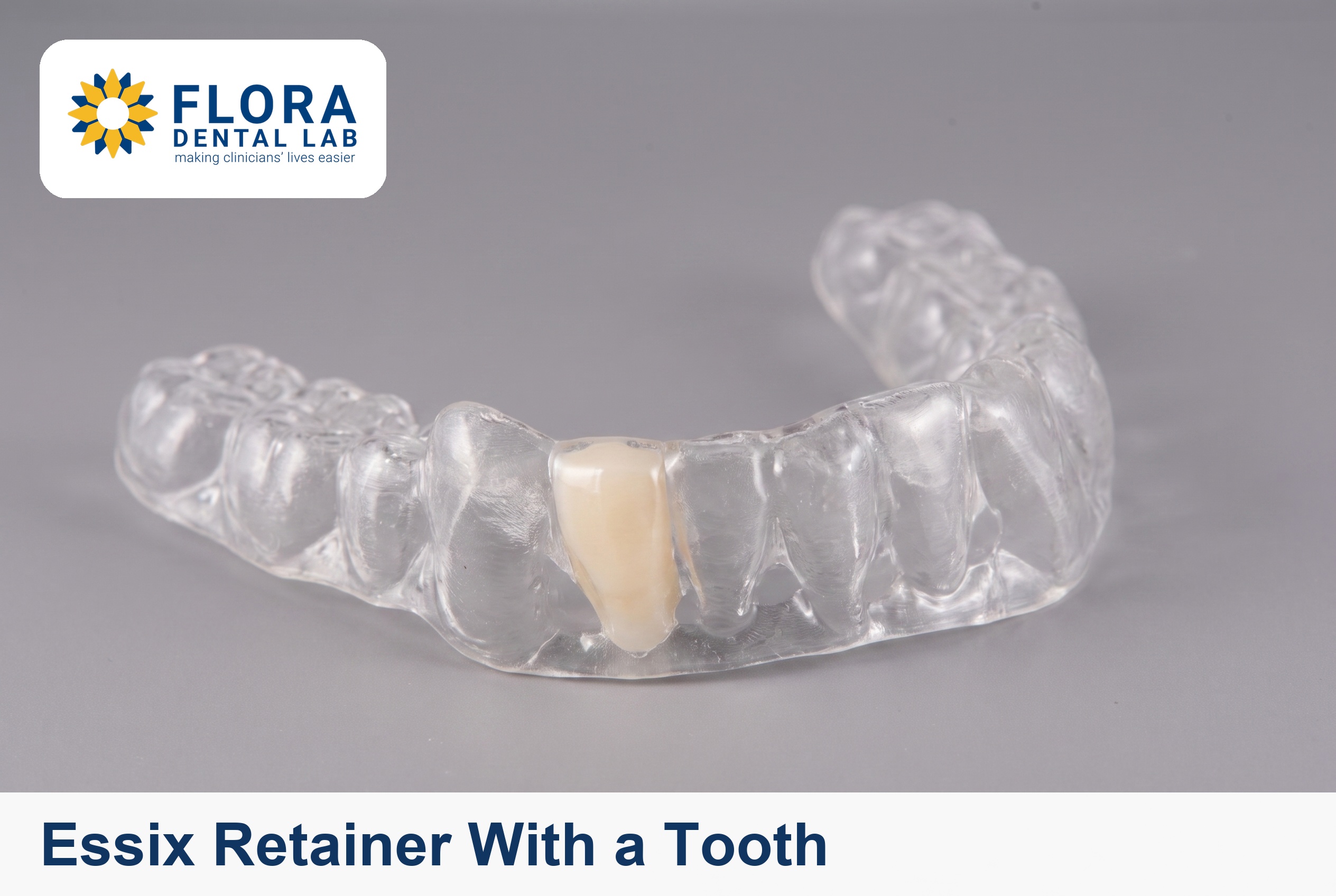
An Essix retainer with a tooth is a clear thermoformed tray, fabricated in our UK dental lab, that carries a colour-matched pontic to fill a single edentulous space, whether the gap sits at a front tooth or elsewhere in the arch. It is a transitional, tooth-borne appliance, useful while a patient heals towards an implant or a definitive restoration. This guide covers when it works as a temporary single-tooth solution, where its limits are, the flipper and denture alternatives, and exactly what we need from you to fabricate one.
For UK practices, once a scan or impression reaches our GDC-registered, DAMAS-accredited (DAMAS 230697) lab, pontic retainers typically turn around same-day or next-day, so patients spend minimal time with visible missing teeth. If the case moves on to a definitive crown, bridge or implant restoration once healing completes, that work runs on our standard 10 working day turnaround, and every case ships back by tracked courier to practices across England.
An essix retainer with a false tooth sits inside our wider orthodontic appliances range, alongside clear and wire retainers, splints and clear aligner work. This page focuses on the pontic version: the clear tray that doubles as a provisional tooth replacement.
What an Essix Retainer With a Tooth Actually Is
An essix retainer with a tooth, also called a pontic retainer or an essix partial, is a single clear tray that covers the arch and holds a tooth-coloured pontic in the gap. The tray maintains the position of the adjacent teeth, exactly as a plain retainer does, while the pontic restores the look of the arch. It is one appliance doing two jobs at once.
The pontic is built into the thermoplastic. We either bond a prefabricated denture tooth into the tray over the edentulous site or fill the space with a tooth-coloured composite and characterise it to the shade you send. The result is a low-profile, metal-free appliance that the patient removes for cleaning.
- Function: transitional. It maintains alignment and masks a single missing tooth. It is not a load-bearing restoration.
- Support: tooth-borne. The tray rests on the standing teeth, not on the soft tissue or a healing socket.
- Best fit: one missing tooth, typically anterior, where aesthetics matter and the patient is between extraction and a definitive plan.
When It Works as a Temporary Single-Tooth Solution
The appliance earns its place in a few clear scenarios. In each, the patient needs the gap covered for a defined window, not forever, and the priority is appearance over chewing function.
- Implant healing: after extraction and placement, while osseointegration runs its course. Because the retainer is tooth-borne, it keeps pressure off the surgical site.
- Post-extraction holding: an immediate, removable way to fill an anterior gap the day a tooth comes out, before the longer-term plan is decided.
- Congenitally missing teeth: after orthodontic treatment closes or opens a space, the pontic retainer holds the result and fills the gap until the patient is ready for an implant or bridge.
- Aligner cases: as an aesthetic placeholder during clear aligner therapy where a unit is missing, then carried over into retention.
The common thread is a patient who can wait, wants to look complete in the meantime, and does not need to bite through food on that unit.
The Limits: What to Tell the Patient Up Front
The most common complaint we see, and the one that dominates patient forums, is that the appliance is removed to eat. Set the expectation before fitting and the appliance does well. Leave it unsaid and the patient feels misled.
- Not for chewing: the pontic is cosmetic. Biting and chewing on it risks fracturing the tooth or distorting the tray, so most patients take it out for meals.
- Speech and bulk: full-arch plastic coverage takes a short adjustment period and can affect speech briefly.
- Single units, anterior bias: it suits one tooth, usually in the smile zone. Long spans or posterior load are jobs for a denture or a fixed option.
- Wear life: it is a holding appliance, not a definitive prosthesis. Plan the permanent restoration rather than relying on it indefinitely.
Framed honestly as a transitional, look-good appliance, it is a strong tool. Sold as a tooth replacement that works like a real tooth, it disappoints.
Essix Pontic Retainer vs Flipper
The flipper, an acrylic partial with a clasped or flanged pontic, is the closest alternative and the most common patient question. The split comes down to where the load sits.
- Support: the essix is tooth-borne, so force runs through the standing teeth. A flipper is largely tissue-borne, resting on the ridge and gum.
- Surgical sites: for implant healing the tooth-borne essix keeps pressure off the site, which is why many clinicians prefer it over a flipper during integration.
- Function: a flipper tolerates light function better and can replace more than one tooth. The essix is the more discreet, retention-friendly choice for a single anterior unit.
- Aesthetics: the essix is metal-free and very low profile. A flipper can show clasps or an acrylic flange.
If the case needs a sturdier provisional that can take light bite, the flipper tooth alternative is the better referral. If it needs alignment held and a single gap masked discreetly, the essix wins.
Where a Partial Denture Fits Instead
When the brief grows beyond one tooth or beyond appearance, a removable partial denture is the sounder route. The essix pontic retainer is deliberately minimal, which is its strength and its ceiling.
- Multiple units: two or more missing teeth, or a non-adjacent pattern, are better served by a cobalt chrome or acrylic partial.
- Function matters: if the patient must eat on the appliance, a properly designed partial denture carries occlusal load in a way a pontic-in-tray cannot.
- Longer timelines: where the definitive plan is years away or undecided, a partial is built for that duration.
A useful rule of thumb: one anterior tooth and a known endpoint points to the essix; broader, longer or load-bearing points to a denture or a fixed restoration.
How We Fabricate the Pontic
Fabrication is straightforward once we have an accurate model and a clear instruction on the pontic. We thermoform the tray to the arch, then build the tooth into the edentulous site to your specification.
- Tray: thermoformed clear thermoplastic trimmed to the gingival margin, the same base as our standard essix retainers.
- Pontic build: a prefabricated denture tooth bonded into the tray, or a tooth-coloured composite shaped and characterised to match the neighbours.
- Shade and form: we match the pontic to the shade and tooth shape you specify, so it reads naturally against the standing teeth.
Because it is a single-unit transitional appliance, turnaround is quick relative to crown and bridge work. Tell us the deadline and we will confirm what is realistic.
What the Lab Needs From You
A clean prescription gets the pontic right first time. Send us the following and we can fabricate without back and forth.
- Impression or scan: a digital scan from 3Shape, Medit, iTero or Dexis, or a conventional impression. Capture the full arch and a clear record of the edentulous space.
- Tooth to replace: the FDI number of the missing unit, plus a note on whether the space is to be held as is or modified.
- Shade: the target shade for the pontic, matched to the adjacent teeth.
- Pontic preference: denture tooth or composite fill, and any note on contour, gingival contact or relief over a healing site.
If anything in the prescription is ambiguous, we will query it before we build rather than guess on an aesthetic unit.
Sending a Case to Flora
Flora Dental Lab is a UK lab serving UK practices. We are DAMAS, DLA and GDC accredited, and we accept digital scans from 3Shape, Medit, iTero and Dexis as well as conventional impressions. Pontic retainers sit within our wider retainer and clear appliance work, so they fit naturally alongside the cases you already send.
If you have not worked with us before, your first case is free, up to £100, with no invoice and no contract. Send a single essix retainer with a tooth, judge the fit, the pontic match and the finish, and decide from there.
Can you eat with an Essix retainer with a fake tooth?
It is not designed for it. The pontic is cosmetic, so biting or chewing on it risks fracturing the tooth or distorting the tray. Most patients remove the appliance for meals and clean it before refitting. Set that expectation at fitting.
What is an essix retainer with a fake tooth?
It is a clear thermoformed retainer with a colour-matched pontic built into the gap, also called a pontic retainer or essix partial. It holds the position of the standing teeth while masking a single missing tooth, as a transitional rather than definitive solution.
What are the disadvantages of Essix retainers?
Full-arch plastic coverage can affect speech briefly and adds bulk, and a pontic version is not built for chewing. It suits single anterior units, not long spans or posterior load, and it is a holding appliance rather than a permanent restoration.
How to make an Essix retainer with a tooth?
We thermoform a clear tray to the arch, then build the pontic into the edentulous site, either a bonded denture tooth or a characterised tooth-coloured composite, matched to the shade you specify. We need an accurate scan or impression, the FDI number and the shade.
Essix retainer with a tooth or a flipper, which is better?
The essix is tooth-borne and very discreet, ideal for a single anterior gap and for keeping pressure off a healing implant site. A flipper tolerates light function and more units. See our flipper tooth alternative for when a sturdier provisional is the better call.
How is an Essix retainer with a tooth different from a Hawley retainer?
An essix is a clear, metal-free full-coverage tray, so a pontic can be embedded discreetly. A Hawley uses an acrylic baseplate and a labial wire, which is more adjustable but more visible. Compare our hawley retainers and our wider retainer range to match the case.
