
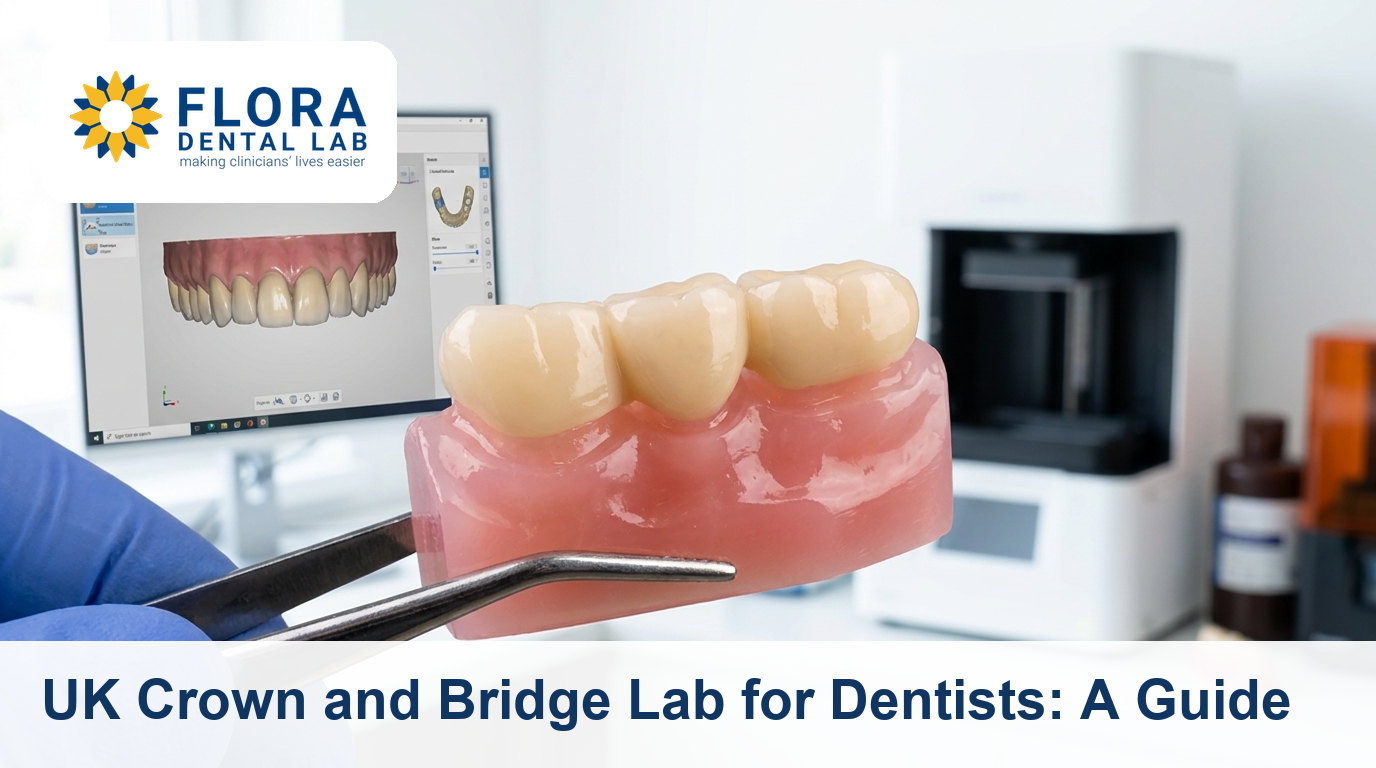
This UK crown and bridge lab guide for dentists covers what our crown and bridge lab fabricates, from a single crown to a multi-unit bridge, what to send, the materials we offer, our digital workflow, and turnaround.
Crown and Bridge Materials at a Glance
| Material | Best for | Preparation | Key consideration |
|---|---|---|---|
| Zirconia (monolithic) | Posterior strength, bruxers, minimal space | Conservative | Strongest option; less translucent than e.max |
| e.max (lithium disilicate) | Anterior and premolar aesthetics | Moderate | Best natural translucency; needs adequate reduction and bonding |
| PFM (porcelain bonded) | Versatile crowns and longer-span bridges | Moderate to heavy | Proven and strong; a metal margin can show over time |
| Full-cast gold | High-load posterior, minimal-space onlays | Very conservative | Kindest to the opposing teeth; not tooth-coloured |
| Bridge (any material) | Replacing a missing unit on sound abutments | Per material and abutment | The prescription and pontic design decide success |
Gold Bridges: Still the Right Call on High-Load Cases
Full-cast gold is not only a single-unit crown material, we cast gold bridges too, most often on a heavy-load posterior span, a minimal-clearance case, or an abutment where sparing the opposing dentition matters more than aesthetics. A gold bridge is not tooth-coloured, so it suits a molar span the patient will not see, not an anterior case. Prescribe the alloy (high noble or noble gold) and the pontic design, and we will cast the framework as one piece to your margins.
UK Context: Registration and Turnaround
Crowns and bridges are custom-made devices under UK MHRA regulations, and we are a GDC-registered (216535) crown and bridge laboratory, a DAMAS and DLA member, so every case ships with a signed statement of manufacture and full material traceability. Whether your team searches for a crown and bridge dental lab or a dental bridge laboratory, the fabrication route, MHRA paperwork and materials are the same. Standard turnaround is 10 working days from a complete case, sent by tracked courier to and from practices across England, not just central London.
Most practices do not keep crown and bridge fabrication in-house, and they should not need to. You diagnose, prepare, and seat. The lab turns your prescription into a restoration that fits the prep and the bite. This guide walks through working with a crown and bridge lab, written for dentists who want predictable units without the guesswork.
What a Crown and Bridge Lab Actually Does
A crown caps a single prepared tooth. A bridge spans an edentulous gap, with retainers cemented to the abutment teeth and one or more pontics filling the space. Both are fixed restorations, and both start the same way at the lab: with your prep, your impression or scan, and your prescription.
Our job is to read the margin, respect the occlusal scheme you have given us, and return a unit that seats with minimal chairside adjustment. We do not change your treatment plan. We execute it in the material you specify, to the shade you record.
- Single crowns: full-coverage restorations on a prepared natural tooth or an implant abutment.
- Conventional bridges: two retainers and one or more pontics, fabricated as a single fixed span.
- Cantilever and Maryland designs: where the clinical case calls for a single abutment or a minimal-prep adhesive wing.
Why Outsource Crown and Bridge to a Lab
Chairside milling suits some single-unit cases, but it ties up surgery time, a mill, and a clinician who could be treating patients. Outsourcing crown and bridge to a dedicated lab keeps that capacity in the practice and puts fabrication with technicians who do it all day.
- Material range: a lab carries pressed, milled, and layered options you would not stock in-house.
- Consistency: the same technicians, the same QA, case after case, so your units behave predictably at seat.
- Capacity: scale up for a busy month without buying equipment or hiring.
- Complex aesthetics: anterior shade matching and characterisation handled by people who do it daily.
If your cases lean cosmetic anterior, our veneer work follows the same workflow. See the veneer lab for dentists.
What to Send Us for a Crown or Bridge
A clean prep and a complete prescription remove most of the back and forth. Whether you work analogue or digital, we need the same clinical information to fabricate a unit that fits the first time.
- The prep detail: a clear, captured margin all the way round, with adequate occlusal and axial reduction for the chosen material.
- An accurate impression or scan: a digital scan or a well-seated conventional impression with no drags or voids at the margin.
- The opposing and the bite: opposing arch plus a bite registration so we build to the patient’s occlusion, not an average one.
- Shade and material: a recorded shade, the material you want, and any notes on translucency, stump shade, or characterisation.
- The prescription: tooth numbers, pontic design for bridges, contact and contour preferences, and your seat date.
Not sure which material fits the case? Compare our e.max crowns.
Materials We Offer for Crown and Bridge
Material choice drives strength, aesthetics, and how much tooth you needed to remove. We fabricate the full range and will advise if a prescription and a prep do not match, but the call stays yours.
- Lithium disilicate (e.max): strong aesthetics for anterior crowns and short-span anterior bridges where translucency matters.
- Zirconia: high flexural strength for posterior crowns and longer-span bridges, in monolithic or layered finishes.
- Porcelain fused to metal: the proven workhorse for bridges where a metal substructure earns its place.
- Full-cast and high-noble alloys: for cases that call for a traditional cast restoration.
For a deeper comparison on the two ceramics dentists ask about most, read our zirconia crowns guide.
If your practice mixes NHS and private work, the material bands differ too. Our guide to NHS vs private dental lab materials explains what changes between the two and why.
Our Digital Crown and Bridge Workflow
If you scan, the case reaches us as an open digital file with no posting, no model wait, and no impression distortion. We accept exports from the main intraoral scanners, design in CAD, and fabricate from there.
- Scanners we accept: 3Shape, Medit, iTero, and Dexis. Export the case and send the file, and we take it from your prep.
- CAD design: we design the crown or bridge to your prescription and share the proposal where a case needs a check before fabrication.
- Fabrication: milled or pressed to the chosen material, finished, glazed, and characterised by hand where the aesthetics demand it.
- QA before despatch: we check margin, contacts, and occlusion against your scan before the unit leaves us.
Still taking conventional impressions? That is fine. Send the impression and the bite, and the rest of the workflow is the same.
Turnaround and Logistics
Plan your seat appointments around a realistic lab schedule rather than a rushed one. Crown and bridge work runs around 10 working days from when we receive a complete case, and a complete case is the variable you control.
- Standard turnaround: around 10 working days for crown and bridge once we have the scan or impression, the bite, and the prescription.
- What slows a case: an unclear margin, a missing bite, or an incomplete prescription that forces us to come back to you.
- Digital cases: skip postage and model time, so a scanned case generally moves through the lab faster than a posted impression.
We work with UK practices and build to UK clinical expectations. Talk to us before you commit a tricky case to a seat date.
Getting the Margin and Fit Right
Most remakes trace back to information the lab never had, not to fabrication. A unit can only be as accurate as the margin we can read and the bite we are given. Two habits remove most issues at seat.
- Capture the whole margin: a margin we can read all the way round lets us seat the restoration to the prep instead of guessing at the finish line.
- Record the real bite: a proper bite registration means the occlusion is right at try-in, not something you grind in chairside.
- Flag the difficult cases: sub-gingival margins, tight inter-occlusal space, or demanding anterior shades. Tell us up front and we plan for them.
When the inputs are clean, the unit seats with minimal adjustment, which is the whole point of sending the case out.
Sending Your First Case to Flora
The honest way to judge a crown and bridge lab is to seat a unit it made, not to read about it. So we make that easy to try without committing your whole caseload.
- First case free: your first crown or bridge unit is on us, up to £100 in value. No invoice and no contract.
- Send a scan or an impression: use 3Shape, Medit, iTero, or Dexis, or post a conventional impression with the bite and your prescription.
- Judge it at seat: assess the margin, the contacts, and the occlusion in the mouth, then decide whether to send us the next one.
Flora Dental Lab is DAMAS, DLA, and GDC registered. To start a case or ask about a specific prescription, get in touch and we will tell you exactly what to send.
What is the difference between a crown and a bridge?
A crown caps a single prepared tooth to restore its shape, strength, and appearance. A bridge replaces one or more missing teeth by spanning the gap, with retainers cemented to the abutment teeth on either side and a pontic filling the space. A bridge effectively uses crowns as anchors.
What materials do you offer for crown and bridge?
We fabricate lithium disilicate (e.max), zirconia in monolithic or layered finishes, porcelain fused to metal, and full-cast alloys. The right choice depends on the tooth position, the span, the aesthetics, and how much reduction the prep allowed. zirconia crowns
How long does crown and bridge work take at the lab?
Crown and bridge work runs around 10 working days from when we receive a complete case, meaning the scan or impression, the opposing arch, a bite registration, and a clear prescription. Digital scans move through faster than posted impressions because they skip postage and model time.
Can I send digital scans for crown and bridge?
Yes. We accept intraoral scan exports from 3Shape, Medit, iTero, and Dexis. Send the file with the bite and the prescription, and we design in CAD and fabricate from your prep. No posting and no impression distortion.
What do I need to send for a crown or bridge?
A clearly captured margin, an accurate scan or well-seated impression, the opposing arch with a bite registration, a recorded shade, your chosen material, and a prescription with tooth numbers and pontic design for bridges. A complete case is what lets the unit seat the first time. e.max crowns
How do I try Flora as a crown and bridge lab?
Send us your first case and it is free, up to £100 in value, with no invoice and no contract. Send a scan or a conventional impression with the bite and prescription, then judge the unit at seat. Flora Dental Lab is DAMAS, DLA, and GDC registered.
How Much Are Lab Fees for a Crown in the UK?
Lab fees for a crown vary by material and complexity, so we quote per case rather than publish a flat rate: an e.max anterior crown, a zirconia posterior crown and a PFM unit each carry different fees. To see our pricing against a real case with no risk, your first crown or bridge unit is free, up to £100 in value, with no invoice and no contract.
How Does a Dentist Choose a UK Dental Lab?
Check registration first: GDC-registered technicians, DAMAS and DLA membership, and MHRA compliance for custom-made devices. Then look at turnaround (we run 10 working days from a complete case), scanner compatibility (we accept 3Shape, Medit, iTero and Dexis), and material range. The only way to judge fit and communication is to seat a unit, which is why we offer a free first case, up to £100, before you commit any caseload.
