
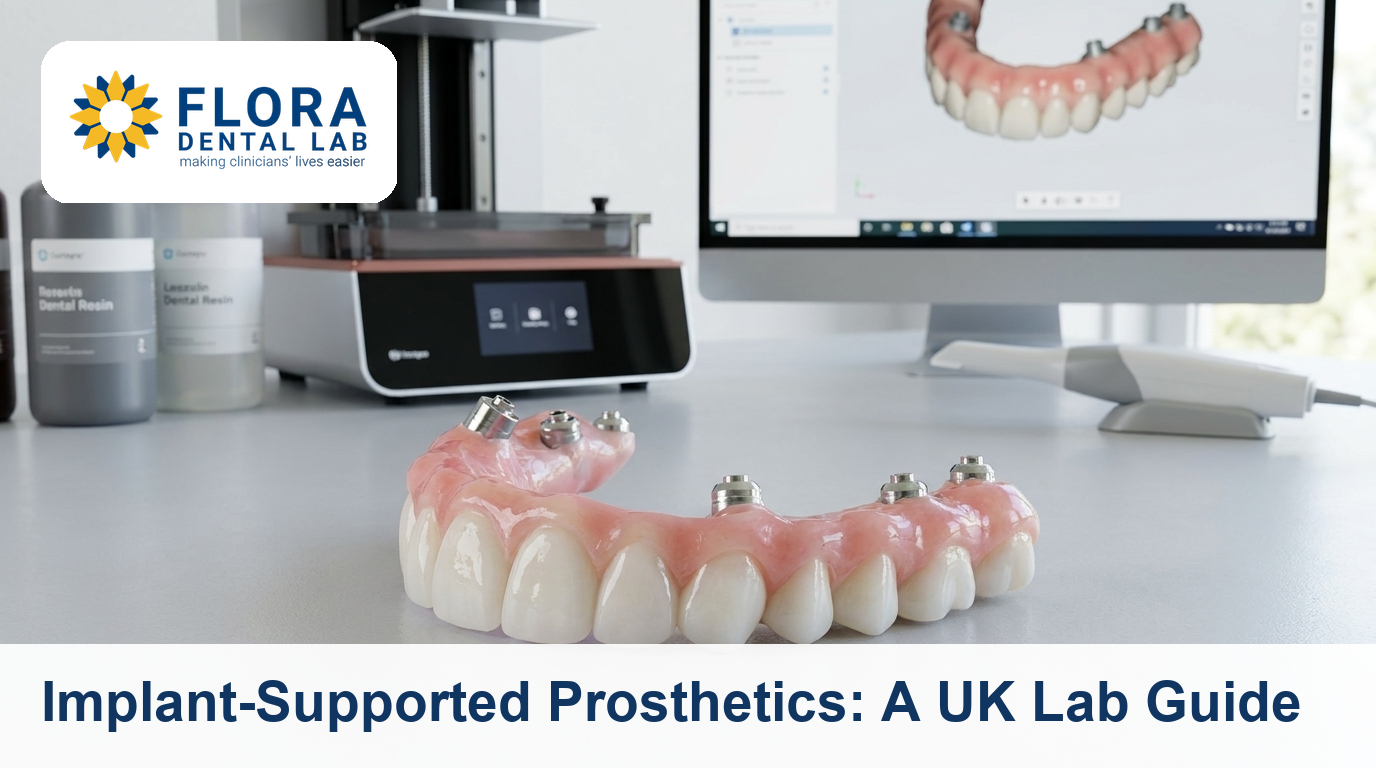
This UK lab guide covers implant-supported prosthetics: All on 4 dental implants restore a full arch on four fixtures, and this guide covers the prosthetic options we fabricate for practices across England, from single crowns to full-arch bridges and overdentures, and what to send us.
We are a GDC-registered UK dental laboratory (DAMAS and DLA registered). Implant-supported restorations turn around in 10 working days from a complete case, then travel to your practice anywhere in England by tracked courier.
We fabricate the full range of implant-supported restorations for UK practices, from a single screw-retained crown to a full-arch all on 4 bridge. This guide sits under our implant restoration lab service and explains the prosthetic side: the options, the materials, and exactly what we need from you to deliver a passive, well-fitting result.
The Range of Implant-Supported Prosthetics We Fabricate
Implant-supported prosthetics cover everything that sits on a fixture rather than on natural tooth structure. The right design depends on how many teeth are missing, the number and position of implants, and whether the case is screw or cement retained. As a lab we fabricate the full span, and the planning decisions made at impression stage carry through to the final fit.
- Single crown: one implant, one unit. Screw-retained where access allows, cement-retained where the screw channel would exit through the facial.
- Implant bridge: a multi-unit fixed restoration on two or more implants, splinting the prosthesis across the span.
- Full-arch fixed bridge: the all on 4 and all on 6 approach, a complete arch carried on four to six implants.
- Implant supported denture: a removable overdenture retained by locators or a bar, for cases where a fixed solution is not indicated.
Each of these starts from the same input, an accurate impression or scan plus the implant and component data. The sections below break down each option.
Single Implant Crowns
A single implant crown is the most common implant restoration we fabricate. The first decision is retention. Screw-retained is our default where the access channel exits through or near the cingulum or central fossa, because it is retrievable and removes the risk of subgingival cement. We move to cement-retained only when the screw channel would breach the facial surface and compromise aesthetics.
- Screw-retained: the crown is fabricated to a Ti-base or directly to the implant connection, with the access channel positioned for retrievability.
- Cement-retained: a separate abutment carries the crown. We fabricate or select the abutment, then build the crown over it.
- Material: monolithic zirconia or lithium disilicate for most posterior and anterior units, layered where high anterior aesthetics are required.
Abutment selection is the variable that most affects the final result. We cover stock, Ti-base, and custom abutment choices in our guide to implant abutments and components.
Implant Bridges
An implant bridge splints two or more implants under one fixed prosthesis, or spans a pontic between two implant-supported units. The design logic is similar to a conventional fixed bridge, but the fit tolerance is tighter because implants have no periodontal ligament to absorb misfit. A passive fit is not optional here, it is the difference between a stable restoration and screw loosening or fracture down the line.
- Connector design: we size connectors to the prosthetic material and span. Zirconia connectors are dimensioned to resist fracture across pontics.
- Retention: screw-retained wherever possible for retrievability across a multi-unit span.
- Verification: for longer spans we recommend a verification jig stage before fabricating the definitive framework.
If you are weighing an implant bridge against a tooth-supported one, our dental bridges lab guide covers the conventional side.
All on 4 and Full-Arch Fixed Prosthetics
All on 4 dental implants carry a complete fixed arch on four fixtures, typically two placed axially in the anterior and two tilted distally to use available bone and avoid grafting. All on 6 adds two fixtures for longer or higher-load arches. From the lab side, the full-arch case is the most demanding work we do, because the prosthesis must seat passively across all the fixtures at once.
- Provisional stage: an immediate fixed provisional, often the same-day teeth in a day arch, lets the patient leave with function while integration completes.
- Verification jig: we strongly recommend a jig to confirm the implant positions transfer accurately before we fabricate the definitive framework.
- Definitive framework: a milled titanium or zirconia bar carries the arch. Material choice depends on opposing dentition, load, and aesthetic demand.
- Prosthetic teeth: monolithic zirconia for strength, or acrylic teeth on a titanium bar where future repairability matters.
Full-arch cases benefit most from a digital workflow. A clean intraoral scan with scan bodies, or an accurate verified impression, is what lets us deliver a framework that seats without strain.
Implant Supported Dentures and Overdentures
An implant supported denture is a removable overdenture retained by implants rather than resting on the ridge. It suits cases where a fixed full arch is not indicated, where the patient prefers to remove the prosthesis for cleaning, or where budget and bone make an overdenture the sounder choice. The denture stays mucosa-borne for support but gains retention and stability from the implants.
- Locator-retained: two to four implants with locator attachments. Simple, serviceable, and the most common overdenture design we fabricate.
- Bar-retained: a milled or cast bar splinting the implants, with clips or attachments in the denture. More retentive, more rigid, more lab work.
- Maintenance: locator inserts are wear parts. We supply the matching components so the practice can refresh retention chairside.
The choice between fixed and removable is a clinical one. We fabricate either, and we will discuss the trade-offs on the case if you are undecided.
Retention, Torque, and Component Accuracy
Implant prosthetics live or die on component accuracy. Every screw-retained restoration we deliver is built to the correct platform and connection, and we expect the practice to seat it to the manufacturer’s prosthetic torque. Under-torque loosens, over-torque damages the screw or the connection. We do not guess this.
- Connection match: we fabricate to the exact implant system and platform you specify. A mismatch is the single most common cause of a non-seating restoration.
- Prosthetic screws: we supply the correct screws for the components used, not generic substitutes.
- Torque values: follow the system’s prosthetic torque, not the surgical placement torque. Our implant torque values guide lists the values by system.
Telling us the implant system, the platform diameter, and the connection type at case submission prevents the most common remakes in implant work. implant torque values guide
The Digital Lab Workflow
Most implant cases now reach us digitally, and full-arch work benefits the most. We accept files from 3Shape, Medit, iTero, and Dexis scanners. A clean scan with the correct scan bodies removes the distortion that creeps into closed-tray impressions, and it lets us design and mill the framework in CAD before anything is physically made.
- Scan bodies: use the scan body matched to the implant system. A wrong or worn scan body throws off the whole design.
- Capture: scan the full arch, the opposing arch, and the bite. For full-arch cases capture soft tissue clearly for emergence design.
- Analogue still works: we accept conventional open-tray impressions too. Send the impression, the analogues, and the bite registration.
Whether digital or analogue, the principle is the same. Accurate input gives a passive fit, and a passive fit is what makes implant prosthetics last.
Sending an Implant Case to Flora
We are a UK lab working with UK practices, accredited to DAMAS, DLA, and GDC standards. Turnaround for implant crown and bridge work is around 10 working days from receipt of a complete case, and full-arch cases are scheduled individually given the verification stages involved. Send us a complete case and we keep that timeline honest.
- Implant data: system, platform diameter, and connection type for every fixture. This is non-negotiable for a seating restoration.
- Impression or scan: a verified open-tray impression with analogues, or a digital scan with the correct scan bodies.
- Prescription: retention preference, shade, material, and any aesthetic notes.
If you have not worked with us, your first case is free up to £100, with no invoice and no contract. Send one implant crown or a small bridge, judge the fit and finish, then decide.
How long will all on four dental implants last?
The implants themselves are designed to last many years when integrated and maintained. The prosthesis on top is a serviceable component. A monolithic zirconia full-arch bridge is highly durable, while acrylic teeth on a titanium bar are built to be repaired and refreshed over time. Maintenance, hygiene, and bite control drive prosthesis longevity more than the material alone.
What is better than All-on-4 implants?
It depends on the case rather than one option being universally better. All on 6 spreads load across more fixtures for longer or heavier-load arches. An implant supported denture suits patients who want a removable, easily cleaned solution. For partial spans, an implant bridge or single crowns are the right call. We fabricate all of these and the choice is clinical, not a ranking.
Can you have all on four dental implants on both arches?
Yes. All on 4 is planned per arch, so a patient can have an upper and a lower full-arch restoration, each on its own four fixtures. From the lab side we fabricate each arch to its own implant positions and bite, then verify the occlusion between them.
Should an implant crown be screw-retained or cement-retained?
We default to screw-retained because it is retrievable and avoids subgingival cement, which is a known cause of peri-implant problems. We move to cement-retained only when the screw access channel would exit through the facial surface and harm aesthetics. Tell us your preference and we will advise on the case if the access position is borderline.
What do you need to fabricate an implant supported denture?
We need the implant system and platform for each fixture, a verified impression or scan with the correct scan bodies, the bite registration, and your retention preference, whether locator-retained or bar-retained. For a bar design we may recommend a verification stage before milling the bar.
What scanners and impression methods do you accept for implant cases?
We accept digital scans from 3Shape, Medit, iTero, and Dexis using the scan body matched to the implant system, and we accept conventional open-tray impressions with analogues and a bite registration. Either route works, the priority is an accurate input that lets us deliver a passive fit. See our implant abutments and components guide for the prosthetic component detail.
