
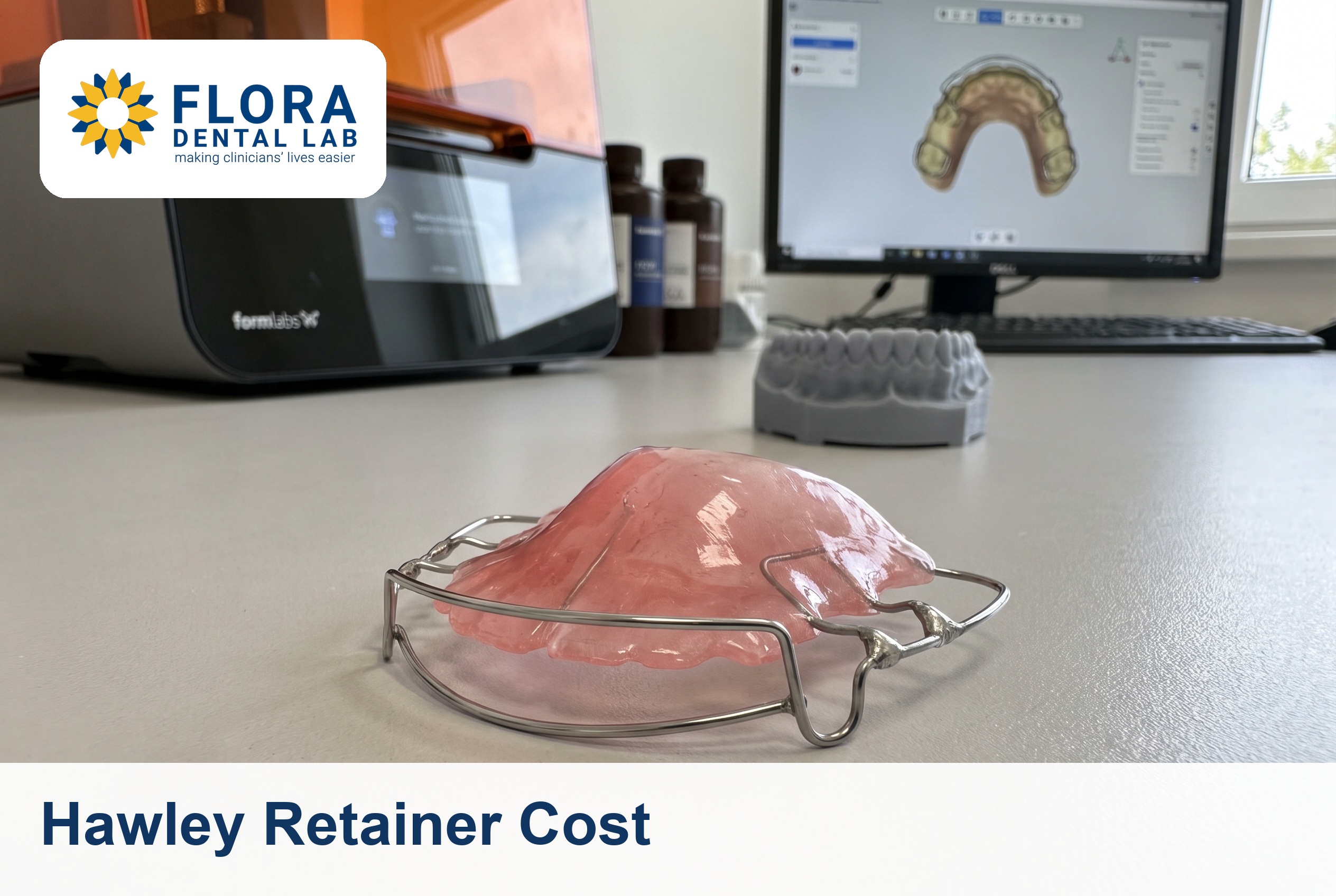
Hawley retainer cost is one of the first questions a patient asks once active treatment ends, and it usually lands on you, not the lab. This guide breaks the figure into its two real parts, the chairside fee you set and the lab fee we charge, so you can quote with confidence and explain the price without guessing.
A Hawley is one of several appliances we fabricate, so it helps to read this alongside the wider orthodontic appliances we supply to UK practices.
What Hawley Retainer Cost Actually Covers
When a patient searches for what a Hawley retainer costs, they see a single number. What that number hides is two separate lines. There is the clinical fee for your chair time, the impression or scan, the fit and any review, and there is the lab fee for the appliance itself. The lab fee is the smaller of the two, but it is the part most often misunderstood when a quote feels high.
Splitting the figure this way is the fastest route to a price the patient accepts. It also makes the question of how much is a Hawley retainer easy to answer honestly, because you can show that the appliance is one component of a clinical service, not the whole of it.
- Clinical fee: your chair time, records, fit and review. Set by you, varies by practice.
- Lab fee: fabrication of the retainer itself. What we quote you per arch.
- Patient-facing price: the two combined, which is the number that appears in price guides online.
What Drives the Lab Cost of a Hawley
A Hawley is a labour appliance. The lab cost reflects skilled bench time more than raw material, which is why two Hawleys can carry different fees even when the prescription reads the same. A few variables move the line.
- Wire design: a simple labial bow on a single arch is quicker to bend than a retainer with adjustment loops, finger springs or a soldered component.
- Acrylic work: a standard baseplate is routine. A custom palatal shape, a stippled finish or colour and glitter acrylic adds hand-finishing time.
- Arch count: an upper and lower set is close to double the bench work of a single arch, so the fee scales accordingly.
- Case condition: a clean digital scan or a well-taken impression fabricates cleanly. A poor impression means a repour or a remake, and that cost has to live somewhere.
The cleaner the record we receive, the tighter the lab cost stays. That is true for every appliance we make.
Hawley vs Essix Cost: Where the Difference Comes From
Hawley vs Essix cost is the comparison patients raise most, usually because they have read that one is cheaper than the other. The honest answer is that the difference is real but smaller than most assume, and it comes down to how each is made.
An Essix is a single thermoformed sheet over a model, a fast process with little hand-finishing. A Hawley is bent wire, soldered or adjusted components and a hand-trimmed acrylic baseplate. More bench time means a Hawley usually carries a slightly higher lab fee per arch. What the patient gains for that is an adjustable, repairable appliance that a dentist can tweak, rather than a part that is replaced when the fit drifts.
- Essix: thermoformed, lowest bench time, lowest lab fee, but replaced rather than adjusted.
- Hawley: wire and acrylic, more bench time, slightly higher lab fee, adjustable and repairable.
For a fuller side by side, read our guides to hawley retainers and Essix.
Single Arch, Both Arches, New or Replacement
Most price confusion comes from comparing figures that are not the same thing. A single arch quote and a both-arches quote are roughly a factor of two apart, and a first retainer included at the end of treatment is a different conversation from a paid replacement two years later.
- Single arch: one upper or one lower. The base unit most lab fees are quoted against.
- Both arches: an upper and lower set, close to double the lab work and the patient price.
- First retainer: often folded into the treatment fee, so the patient may never see a separate line.
- Replacement: a fresh record and a fresh fabrication, billed in full, which is where most cost questions actually arise.
When you quote, name which of these you mean. It removes the gap between what the patient expected and what they are charged.
The UK Retainer Cost UK Picture
Retainer cost UK figures sit lower than the US numbers that fill most search results, and the spread is wide. UK private practices commonly publish removable retainer prices from roughly £99 to £295 per arch, with some quoting around £160 per arch, while fixed retainers tend to be priced separately and higher. Those are patient-facing prices that bundle your chair time, not lab fees.
The point for your practice is not to match any single published figure. It is to know which part of your own price is clinical and which part is the lab line, so that when a patient quotes a number they found online you can explain calmly what it does and does not include.
What to Tell the Patient About Cost
Patients accept a price they understand. The cost conversation goes more smoothly when you frame the Hawley as a long-term appliance rather than a one-off purchase, and when you separate value from headline price.
- It lasts: a well-made Hawley typically serves for years with care, which reframes the fee as a cost spread over time.
- It is adjustable: unlike a clear retainer, a Hawley can be tweaked in the chair, so minor relapse does not always mean a remake.
- Replacement is the real risk: loss or breakage drives the next cost, so retainer care is the cheapest thing a patient can do.
- First versus future: be clear whether this retainer is included in treatment or billed on its own.
How a Digital Workflow Changes the Cost Equation
The single biggest avoidable cost in any retainer case is the remake, and remakes almost always trace back to the record. A distorted impression, a torn margin on the model or a drag on removal can all force a refabrication that nobody wants to pay for.
A digital scan removes most of that risk. We accept files from 3Shape, Medit, iTero and Dexis, and a clean intraoral scan fabricates predictably the first time. Fewer remakes means a more stable lab line for you and a faster, calmer experience for the patient. The same logic applies across the wider range of orthodontic appliances we make.
Sending a Hawley Case to Flora
Flora Dental Lab is a UK lab supplying UK practices. We fabricate Hawley retainers from a scan or an impression, with the wire and acrylic options your case needs, and we hold DAMAS, DLA and GDC registration so the appliances meet the standards your patients expect.
If you want to see the quality and the lab line before you commit, your first case is free, up to £100 in value, with no invoice and no contract. Send a scan from 3Shape, Medit, iTero or Dexis, or a traditional impression, and we will fabricate it so you can judge the fit and finish on your own patient.
Want to compare appliance types before you prescribe? Read our essix retainers next.
How much do Hawley retainers cost?
A patient-facing Hawley price combines your clinical fee and the lab fee. UK removable retainer prices are commonly published from around £99 to £295 per arch, but the lab fee for the appliance itself is the smaller part of that figure. The exact number depends on arch count, wire design and whether it is a first retainer or a replacement.
How much are Hawley retainers in the UK?
UK private practices typically publish removable retainer prices from roughly £99 to £295 per arch, with some quoting around £160 per arch. These are patient-facing prices that include chair time, records and fit, not the lab fee alone. Fixed retainers are usually priced separately.
Why are Hawley retainers so expensive?
A Hawley is a labour appliance. The fee reflects skilled bench time spent bending wire, finishing acrylic and adjusting components, plus your clinical time for records and fit. The material itself is a small share. Higher-quality fabrication and custom features such as colour acrylic add hand-finishing time, which is what moves the price.
Is a Hawley retainer cheaper than an Essix?
Usually a Hawley carries a slightly higher lab fee than an Essix because it needs bent wire and hand-trimmed acrylic, while an Essix is a single thermoformed sheet. The gap is smaller than most patients expect. What the higher fee buys is an adjustable, repairable appliance rather than one that is replaced when the fit drifts. essix retainers
What factors affect Hawley retainer price?
Arch count, wire design, the amount of custom acrylic work, and the quality of the record we receive. A single arch with a simple labial bow is the base case. Adjustment loops, soldered components, colour acrylic or a poor impression that forces a remake all push the price up. hawley retainers
How much is a replacement Hawley retainer?
A replacement is billed in full because it needs a fresh record and a fresh fabrication, unlike a first retainer that may be folded into the treatment fee. This is where most cost questions arise. A digital scan reduces the risk of a remake, which keeps the replacement cost predictable.
