.svg)
Zirconia Crowns: A Lab Guide for Dentists
For most practices, zirconia is now the default posterior crown — and that is exactly where the modern mistake hides. "Zirconia" is no longer one material. The shift from first-generation opaque 3Y zirconia to today's 4Y and 5Y high-translucency formulations means a single word now covers materials ranging from nearly unbreakable to genuinely aesthetic — with very different strength. Prescribing "a zirconia crown" without specifying the generation is like prescribing "a ceramic": the lab has to guess which trade-off you wanted.
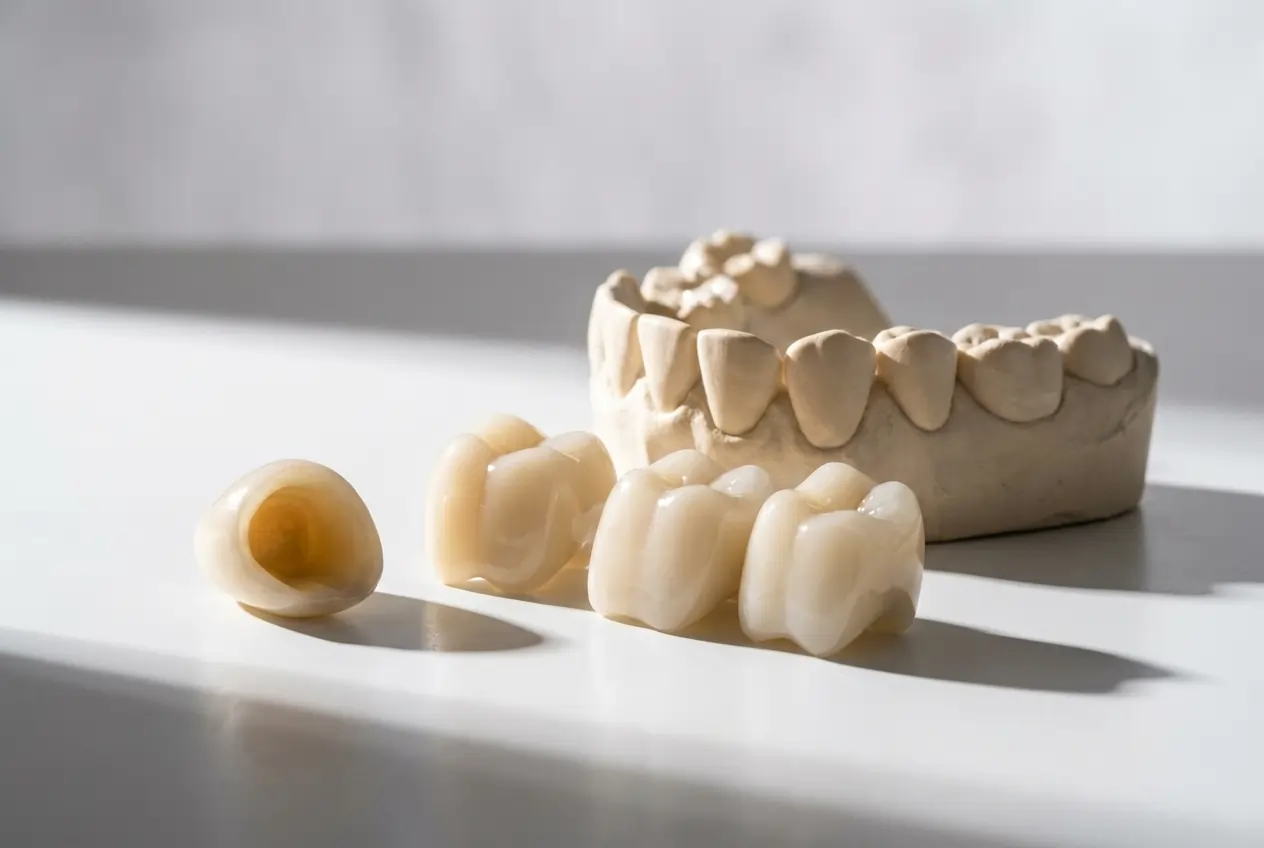
Want to learn more about the inside of a dental lab ? Check our article about crown and bridges at Flora.
This guide sets out the part of zirconia that actually drives outcomes — the yttria strength–translucency trade-off, the three restoration types built from it, how we fabricate them at Flora, and the preparation and cementation specifics that differ meaningfully from e.max.
The One Thing to Understand Yttria, Strength and Translucency
Zirconia is stabilised with yttria (yttrium oxide). The amount of yttria, written as a mol% 3Y, 4Y, 5Y is the single most important variable in a modern zirconia prescription. The relationship is a straight trade-off: more yttria means more translucency and better aesthetics, but lower strength and fracture toughness.
A practical reading: if a case is load-bearing — molars, bruxism, a long span — you want 3Y and you accept lower translucency. If a case is a visible anterior unit, 4Y or 5Y buys you the aesthetics, and you accept that it is no longer a 1,400 MPa material. The error to avoid is putting a 5Y crown on a bruxer's molar because someone asked for "aesthetic zirconia," or a 3Y crown on a central incisor and wondering why it looks flat.
MPa figures are typical manufacturer ranges by generation; exact values vary by brand.
The Three Types of Zirconia Restoration
Those generations are delivered as three restoration types. Choosing between them is the core zirconia decision.
Monolithic zirconia is the workhorse — strength first, milled from one block. Translucent/aesthetic (4Y–5Y) is the single-unit compromise that gives visible crowns acceptable aesthetics without dropping to e.max-level strength. Layered zirconia (PFZ) puts a high-strength core under hand-applied porcelain for the best anterior result and has largely replaced PFM — at the cost of a porcelain layer that can chip and a deeper preparation requirement.
How the Lab Makes a Zirconia Crown
Zirconia has one fabrication step that no other crown material shares, and it explains several of its clinical quirks.
- Impression or scan — a digital intraoral scan or a model poured from a conventional impression.
- CAD design — margins, contours, occlusion and contacts designed digitally.
- CAM milling — the crown is milled from a soft, chalk-like pre-sintered "green-state" disc, deliberately oversized by roughly 20–25%.
- Colouring (green state) — the milled crown is dipped or painted with shading liquids to set the base shade before firing.
- Sintering — the crown is fired in a furnace at roughly 1,450–1,550 °C. The particles fuse, the crown shrinks by 20–25% to its exact final dimensions, and only now does it reach full hardness and translucency.
- Characterisation and glaze — staining for natural gradients and a glaze for a smooth, plaque-resistant surface.
The sintering shrinkage is why the digital design and milling have to be precise to the micron — the final size is engineered into an oversized milled blank. The post-sinter hardness is why chairside adjustment is difficult: once fired, zirconia is extremely hard, and aggressive grinding generates heat that can introduce micro-cracks.
Zirconia vs e.max and vs PFM
We made a full article about zirconia vs e.max you can check it or just check about metal and PFM crowns.
This is the everyday material decision. The short version: strength → zirconia, maximum translucency → e.max.
Against PFM, modern zirconia (and layered PFZ specifically) wins on the two things PFM is criticised for: no grey metal margin if the gingiva recedes, and full metal-free biocompatibility — while matching or exceeding PFM strength. For most practices, PFZ is now the natural replacement for the old PFM prescription. For the aesthetic side of this decision, see our e.max crowns guide.
Preparation Guidelines for Zirconia
Zirconia's strength allows a more conservative preparation than e.max — but "conservative" is not "minimal," and the margin and taper rules still matter.
Across all zirconia preparations:
- Shoulder or chamfer margins are ideal. A feather edge is not recommended — though, unlike e.max, full-contour monolithic zirconia can sometimes tolerate one. Confirm with the lab before relying on it.
- Round all incisal/occlusal edges and internal line angles — sharp angles concentrate stress.
- No bevels.
- Avoid the preparations zirconia cannot work from: undercuts, gutter preparations, 90° shoulders, parallel (non-tapering) walls, and sharp edges. These are the most common reasons a zirconia case is returned for re-prep.
- Good tissue retraction (double-cord works well) gives the scanner a clean margin — the single biggest driver of digital fit.
Cementation and Finishing Where Zirconia Differs From e.max
This is the section most generic zirconia pages skip, and it is where chairside problems actually happen.
Cementation. Unlike e.max, zirconia has no glass phase to etch, so the e.max protocol (hydrofluoric acid + silane) does not apply. In practice:
- Conventional cementation (RMGI or conventional resin-modified cements) works well for full-coverage crowns with adequate retention — this is the usual route.
- Adhesive bonding, when retention is limited or for thinner restorations, uses an MDP-containing primer/cement (zirconia primer) after air-abrasion of the fitting surface — not HF etching.
Finishing and polishing. Monolithic zirconia must be polished smooth — an unpolished or roughly adjusted zirconia surface is abrasive and will wear the opposing natural dentition. If you adjust chairside, use a fine diamond suitable for zirconia, with water and light pressure, then re-polish: heat and heavy pressure cause micro-fractures, and a rough surface left in occlusion is a known cause of opposing-tooth wear.
When Zirconia Isn't the Answer
Honest limits make the rest of the prescription trustworthy:
- Insufficient occlusal space. Zirconia needs its reduction; where there genuinely is not 1 mm of clearance, the case needs re-prep or a different plan.
- Maximum anterior aesthetics on a thin, well-lit case — a layered PFZ or, for a single visible unit, e.max may integrate better than monolithic zirconia.
- Veneers and ultra-thin restorations — these are e.max territory; monolithic and aesthetic zirconia are not indicated for veneers.
- Unpolished delivery — zirconia is only "kind to opposing teeth" when finished correctly; left rough, it is the opposite.
Sending a Zirconia Case to Flora
To return a zirconia crown you can seat first time, we need:
- Preparation scan or definitive PVS/polyether impression, opposing arch, and bite record
- The generation/aesthetic level you want — 3Y for strength, 4Y/5Y for a visible single unit, or layered PFZ for top anterior aesthetics. If you tell us the case (molar bruxer vs anterior smile-line), we will recommend the right one
- Shade information, with photography for any visible unit
- Cementation intent if it affects the design
We mill monolithic and aesthetic zirconia and hand-layer PFZ, finish and polish to occlusion, and will flag any preparation that falls into the re-prep list above before fabrication rather than after delivery.
Frequently Asked Questions
Our team answer to your questions

The number refers to the yttria content (mol%), which sets the strength–translucency trade-off. 3Y is the strongest (~1,200–1,400 MPa) but least translucent — best for posterior crowns, bruxers and long-span bridges. 5Y is the most translucent and aesthetic but the weakest (~500–750 MPa) — for anterior single units under light load. 4Y sits in between for general single-unit work.
They suit different cases. Zirconia is stronger (up to ~1,400 MPa) and the choice for posterior load, bruxers and long-span bridges, and it allows a more conservative preparation. e.max offers benchmark translucency for anterior single units and veneers but is not suitable for high-load or long-span work. For top anterior aesthetics with zirconia strength, layered PFZ bridges the two.
Posterior monolithic zirconia needs roughly 1.0–1.5 mm occlusal reduction, a wall thickness of at least 0.5 mm, and a ≥0.5 mm chamfer or shoulder margin with a 4–8° taper. Anterior crowns can go to ~0.3 mm wall thickness. Layered PFZ needs more — around 2.0 mm occlusal — to accommodate the porcelain. Shoulder or chamfer margins are ideal; avoid undercuts, 90° shoulders and parallel walls.
Zirconia has no glass phase, so the e.max protocol (hydrofluoric acid + silane) does not apply. Full-coverage zirconia crowns with adequate retention are usually conventionally cemented (RMGI or resin-modified cement). When retention is limited, bond using an MDP-containing zirconia primer after air-abrading the fitting surface — not HF etching.
Only when left rough. Properly polished and glazed monolithic zirconia is gentle on opposing enamel. The wear problem arises from an unpolished surface or a chairside adjustment that was not re-polished. If you adjust zirconia, use a fine diamond with water and light pressure, then polish the adjusted area smooth.
Yes — 3Y monolithic zirconia supports long-span and even full-arch bridges thanks to its strength, which is a key advantage over e.max (limited to 3 units up to the second premolar). Higher-translucency 4Y/5Y is better kept to single units or short spans, where strength is less critical than appearance.