.svg)
The Complete Guide to Bite Registration Techniques for Dental Restorations
Every dental technician working on a crown, bridge, or implant restoration depends on a single clinical record they were not present to take: the bite registration. If that record is inaccurate, everything built on top of it is wrong. The articulator mounts incorrectly, occlusal contacts are off, and the restoration requires chairside adjustment or a remake.
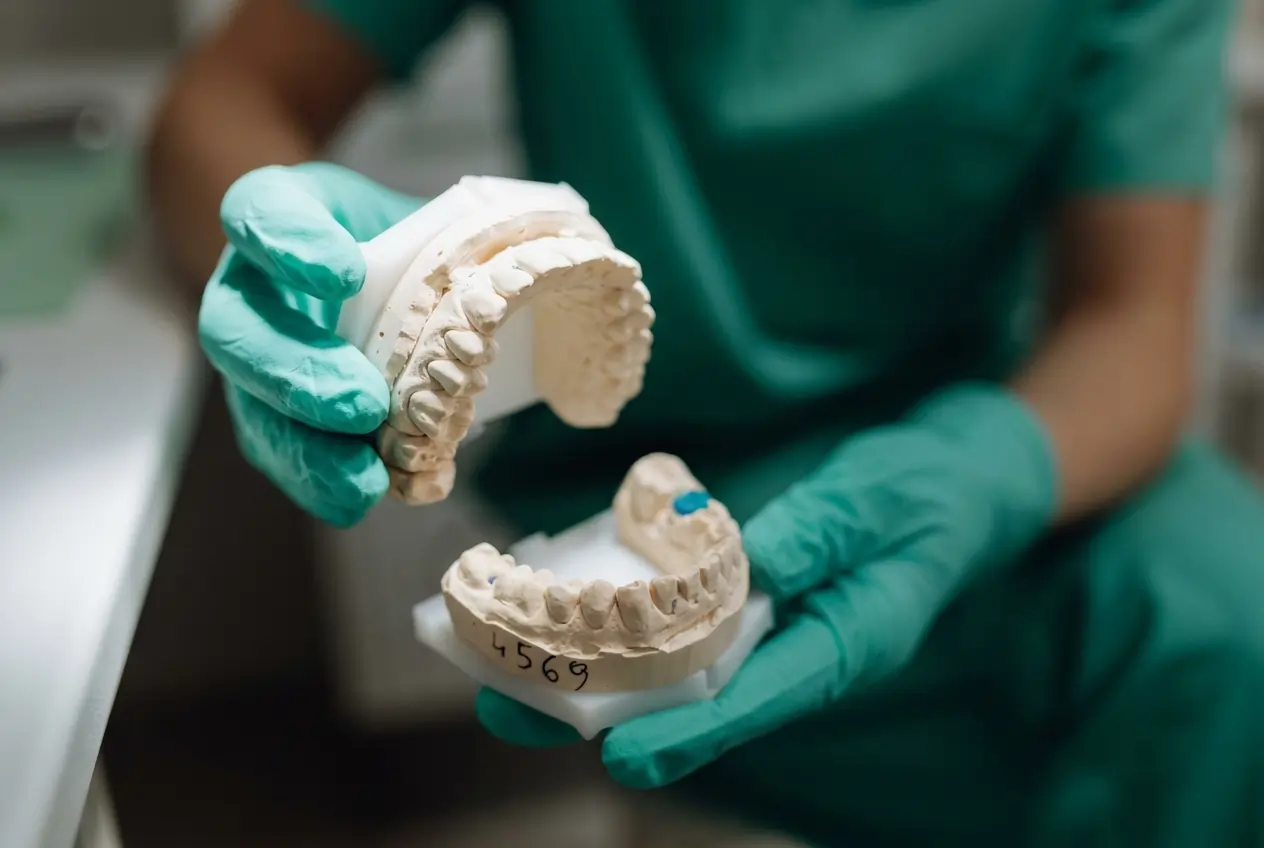
At Flora Orthodontics, we receive hundreds of cases monthly where the quality of the bite registration determines whether the restoration seats at first fit or returns for adjustment. The difference is not technical skill—it is systematic protocol. Dentists who understand when to use ICP versus centric relation, which material suits which case type, and how to communicate mounting requirements experience significantly fewer occlusal remakes.
This guide covers the clinical science and practical protocol behind accurate bite registration: reference positions, material selection, technique by case type, common errors, and the specific information your dental laboratory needs to mount and fabricate without guesswork.
ICP vs Centric Relation: Choosing the Right Reference Position
The foundation of all bite registration is defining which jaw position you are recording. Using the wrong reference is the most frequent source of mounting errors in crown and bridge work.
Intercuspal Position (ICP)
Intercuspal Position (ICP), also called maximum intercuspation, is the position of habitual occlusion—where the teeth come together with maximum contact under normal function. ICP is appropriate for:
- Single-unit crowns
- Short-span bridges (up to 3 units)
- Cases where the existing occlusal scheme is stable
- Patients without TMJ dysfunction or parafunctional habits
ICP is reproducible because it is the position the patient naturally closes to. However, when a tooth is prepared, the patient loses proprioceptive feedback from that position. Left to close freely, the mandible drifts. This is why bite registration must be taken with verification of the contralateral side.
Centric Relation (CR)
Centric Relation (CR) is a musculoskeletally stable position of the condyles in the glenoid fossae, independent of tooth contact. CR is required for:
- Multi-unit reconstructions (4+ units in same quadrant)
- Full-arch rehabilitations
- Cases involving vertical dimension changes
- Patients with active TMD or significant ICP-CR discrepancy
CR is not where patients habitually bite—it must be guided by the clinician through bimanual manipulation or deprogramming. For any case involving more than one unit in the same quadrant, consult your laboratory before recording the bite. The mounting requirements differ, and the technique at the chair must match.
Bite Registration Materials Compared
The accuracy of a bite registration is inseparable from the properties of the material used. Each category solves one problem while creating another.
Clinical Recommendation: For routine fixed prosthodontics, stiff PVS materials (such as Occlufast+, Capture Hard Bite, or Futar Fast) represent the current clinical standard. They combine low resistance to closure with dimensional stability and ease of trimming.
Protocol by Case Type
The bite registration technique must match the clinical situation. One approach does not fit all cases.
Single-Unit or Short-Span Bridge (Posterior, Stable Occlusion)
For routine single crowns or two adjacent units:
- Use a double-arch tray (metal, not plastic) for maximum accuracy—or take a separate PVS bite registration
- Rehearse maximum intercuspation with the patient before placing material
- Express PVS material only over the prepared teeth, not the full arch
- Verify contralateral side is fully seated during closure
- Trim aggressively: Remove all material contacting soft tissue; keep only occlusal/incisal contacts
- Try in before sending to verify stability
Why limited material? Covering the entire arch with bite registration material forces unprepared teeth out of maximum intercuspation. The registration should only capture the prepared tooth and its opposing contact, allowing all other teeth to seat fully.
Multi-Unit Anterior or Aesthetic Cases
For cases involving 4+ units or significant aesthetic demands:
- Use centric relation (CR) as the reference position
- Deprogram the mandible first if any ICP-CR slide is detected (use a leaf gauge or Lucia jig)
- Record in CR using bimanual guidance or chin-point pressure
- Supply the laboratory with:
- CR registration
- Facebow transfer
- ICP photograph for working space assessment
Full-Arch Fixed Reconstruction
Full-arch cases require comprehensive records:
- Facebow transfer is mandatory—without it, the technician cannot correctly orient the maxillary cast to the hinge axis
- CR record using deprogrammer and verified condylar seating
- Protrusive record for semi-adjustable articulator programming
- Lateral records if using fully adjustable articulator
Critical: A single ICP registration is not sufficient data to fabricate a full arch. Cases received without these records will generate a request for remounting information before work begins.
Implant-Supported Restorations
Implants have no periodontal ligament—they do not deflect under load like natural teeth. This means implant crowns routinely test in hyperocclusion in static contact.
For implant cases:
- Take bite registration with patient in relaxed close, not maximum force
- Specify occlusal scheme to the lab: light contact or out of occlusion in ICP?
- Communicate: Should the implant crown be in contact only in excursions?
- Consider verification jig for complex multi-implant cases
Edentulous Patients
Edentulous cases require a fundamentally different approach:
- Construct occlusal rims on record bases first—must be comfortable and retentive
- Establish vertical dimension of occlusion (VDO) on the rims before jaw relation
- Mark reference points: midline, canine lines, smile line, occlusal plane
- Record horizontal jaw relationship at the established VDO—not both simultaneously
- Use wax or ZOE for the final registration; avoid elastomers (incompatible with rim materials)
Important: The bite registration records the horizontal jaw relationship at the established VDO. These are two separate clinical steps that are frequently conflated.
Double-Arch Trays vs Separate Bite Registration
Digital Bite Registration: Current Evidence
Intraoral scanners record jaw relationships using either a physical bite registration scanned as reference, or software-based occlusal mapping where the patient closes under scan guidance.
A 2024 systematic review concluded that digital methods show advantages in speed, accuracy, efficiency, and integration relative to conventional methods. However, the review noted methodological limitations in some included studies, suggesting the evidence direction favors digital but is not yet definitive enough to dismiss conventional methods.
Practical guidance:
- For simple cases, a PVS registration scanned as a physical object provides reliable reference
- For complex cases, IOS-based jaw tracking without a physical record introduces measurement uncertainty
- Confirm with your laboratory which digital formats are accepted and whether physical verification is required
Critical point: Digital does not fix poor clinical closure. It digitizes whatever was recorded. The same biologic and occlusal principles apply.
Five Common Errors That Generate Remakes
1. Recording the bite after dehydration or fatigue
Preparation, retraction, and irrigation alter proprioception. Register the bite before prep or immediately after tissue recovery, never at the end of a long appointment.
2. Insufficient trimming of the registration
PVS material extending beyond the occlusal table creates a spring effect that lifts models apart. Trim aggressively to occlusal-only contacts.
3. Mandibular deflection from material viscosity
High-viscosity materials resist closure and displace the mandible. Use only light-body or medium-body materials; never ask the patient to bite into a loaded tray.
4. Sending the registration without orientation marking
Right, left, anterior, posterior must be clearly indicated. Unlabelled registrations force guesswork at the lab.
5. Taking a single ICP bite for a full-arch case
Full-arch reconstructions require verified CR, facebow transfer, and protrusive records. A single ICP registration is insufficient data.
What Flora Orthodontics Needs From You
A complete bite registration submission should include:
- Material used and date (PVS registrations degrade with UV exposure over time)
- Reference position recorded (ICP or CR)
- Orientation marking: right/left/anterior clearly labelled
- Facebow transfer for any full-arch or VDO-modifying case
- Clinical notes on implant occlusal scheme if implants are involved
- Protrusive record for semi-adjustable articulator programming on posterior cases
- IOS file format if submitting digitally, confirmed against Flora's accepted file list
Cases arriving without a bite registration—or with an unusable one—are held pending clarification. That call costs a turnaround day. The cases that move fastest from receipt to delivery are the ones where the bite record answers every question the technician would otherwise have to ask.
Download Bite Registration Checklist
Frequently Asked Questions
Our team answer to your questions

Use ICP for single crowns and short bridges with stable occlusion. Use CR for multi-unit cases, full-arch work, or when vertical dimension changes. CR requires condylar guidance verification.
Material across the full arch prevents unprepared teeth from seating in maximum intercuspation. Limited material allows natural teeth to guide the mandible to the correct position.
Implants lack periodontal ligaments and do not deflect under load like natural teeth. Take registrations with relaxed closure and specify whether the implant should contact in ICP or only in excursions.
Yes. Without a facebow, the technician cannot orient the maxillary cast to the hinge axis. This leads to arbitrary cusp geometry and occlusal interferences that require chairside correction.
Digital methods offer speed and accuracy advantages but do not eliminate clinical technique requirements. Complex cases often benefit from physical verification alongside digital records.
PVS offers dimensional stability, low resistance to closure, and easy trimming without thermal distortion. Wax expands and contracts with temperature, making it unreliable for precision work.
Observe the contralateral side for full tooth interdigitation. Rehearse the closure before placing material. If unsure after three attempts, take a separate bite registration and note this for the lab.