.svg)
Metal Crowns: PFM, Gold and Full-Cast
A Lab Guide for Dentists
The metal crown has a marketing problem, not a clinical one. Patients arrive at the chair having read that metal crowns are obsolete, allergenic, or even toxic — one widely-ranked patient article claims they contain mercury, which is simply wrong (dental amalgam contains mercury; cast crowns and PFMs do not). Meanwhile, the clinical record tells the opposite story: cast gold remains one of the longest-lived restorations in dentistry, the NHS places metal crowns every working day, and there are still cases where nothing else performs as well.
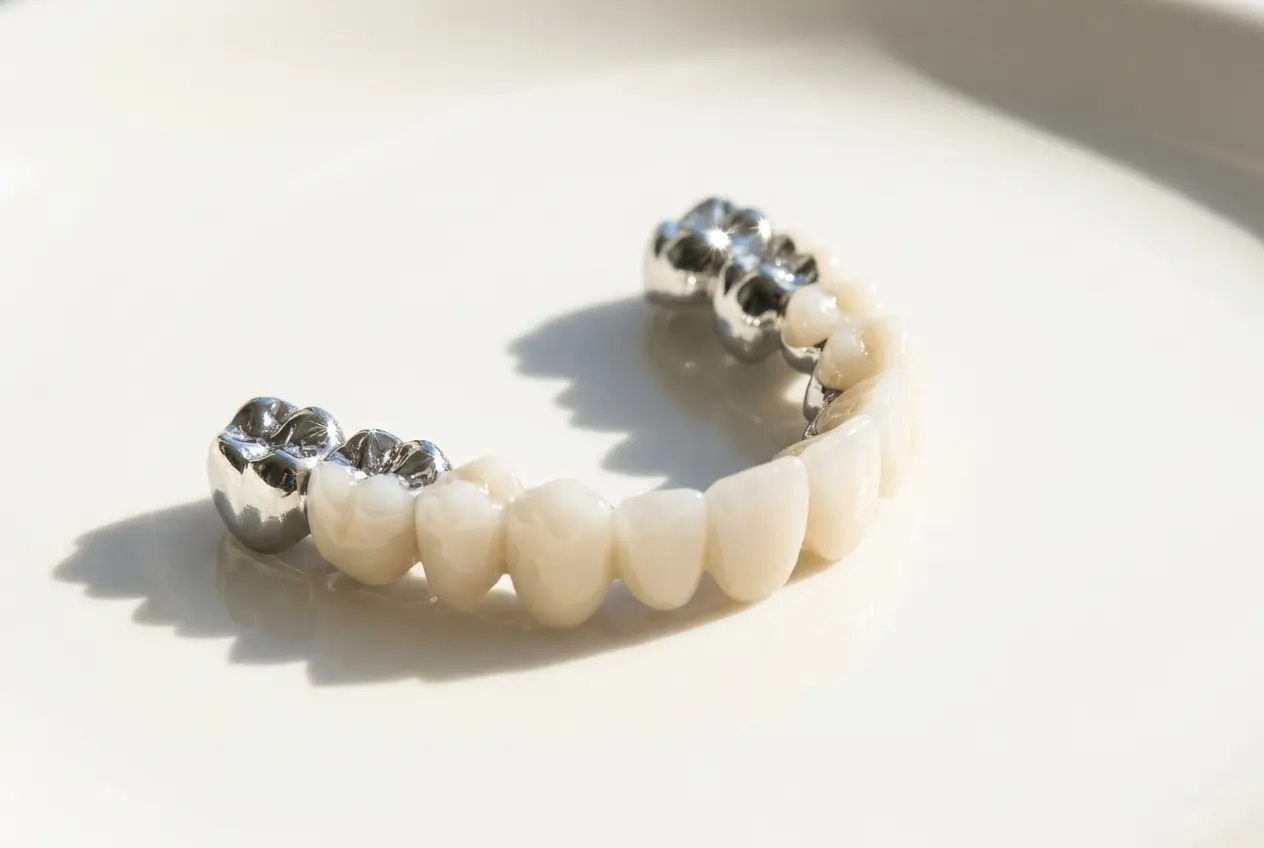
Want to learn more how Flora take care of your case ? See our article about crown and bridges.
This guide covers the metal-based options a laboratory actually makes — full-cast crowns, gold work and PFM (the porcelain bonded crown, as most UK prescriptions call it) — the alloy classes behind them, where each is still the right answer, and what the preparation needs to provide.
The Three Alloy Classes
Every metal prescription starts with an alloy class. The classification is standard:
Two practical notes for the prescription:
- Nickel sensitivity. Ni-Cr alloys can provoke reactions in nickel-sensitive patients (more prevalent in women). Co-Cr is the standard nickel-free base-metal choice; for a patient with documented sensitivity, specify nickel-free or move up to a noble alloy. Flag any allergy history on the prescription — the lab cannot know what you don't write down.
- NHS vs private. In England, lab-made crowns sit in NHS Band 3, and NHS metal work is typically provided in non-precious alloy. Precious-metal crowns are generally a private prescription. If the case is NHS, say so on the docket — it determines the alloy before any other decision.
Full-Cast and Gold Crowns Underused, Not Outdated
The argument for the full-metal crown in selected posterior cases has not changed in fifty years, because the material properties have not changed:
- The most conservative preparation of any crown type. Metal is strong in thin section, so 0.5–1.0 mm of reduction does what ceramics need 1.5–2.0 mm to do. On a short clinical crown or a tooth you want to preserve, that difference matters more than aesthetics.
- Kindest to the opposing tooth. Polished gold wears at close to the rate of natural enamel — no other crown material matches it. For a bruxer whose opposing dentition you want to protect, gold is still the reference answer.
- It does not chip or fracture. There is no ceramic layer to fail. Material failure in cast metal is rare to the point of being reportable.
- Documented longevity. Survival data consistently places cast gold among the longest-lived restorations in dentistry — decades of service is the norm, not the exception.
The honest limitation is the obvious one: it looks like metal. The indication is posterior units outside the smile line — typically second molars, sometimes first molars depending on the patient's display — and patients who value longevity over invisibility.
PFM the Porcelain Bonded Crown
PFM (porcelain-fused-to-metal — written as porcelain bonded crown on most UK prescriptions) puts a cast or milled metal substructure under feldspathic porcelain: metal strength under tooth-coloured ceramic. For decades it was the default crown, and it remains clinically appropriate where:
- the unit is posterior and aesthetics are moderate, not critical
- the case is cost-sensitive but needs better aesthetics than full metal
- the practice prefers a metal-supported restoration for a specific patient or span
The two PFM watchouts a lab will always flag:
- The grey margin. If gingival recession develops, the metal collar shows as a dark line at the gumline. Either plan a porcelain butt margin (needs a shoulder), accept the collar in a non-visible position, or choose an all-ceramic.
- Over-reduction at the collar. The most common PFM prescription problem is a thin metal collar that chips its porcelain early. The preparation geometry must respect the shoulder/chamfer at the porcelain margin and leave room for both metal and ceramic.
Where PFM has genuinely been replaced: for most of what PFM used to do, layered zirconia (PFZ) now does the same job metal-free — no grey margin risk, full biocompatibility, comparable strength. PFM survives as the right choice in the cost-sensitive and metal-preferred niches; it is no longer the default. That is a prescribing decision worth making deliberately rather than by habit.
How the Lab Makes a Metal Crown
Two routes coexist, and both are in daily use:
Lost-wax casting (traditional). The technician waxes the crown to full anatomy on the die, invests it, burns out the wax at temperature, and casts molten alloy into the mould by centrifuge or vacuum. The casting is divested, fitted to the die, finished and polished. For gold work, hand-finishing and margin burnishing are where a good technician earns the fit.
Digital (milling / laser sintering). The crown or substructure is designed in CAD and either milled from an alloy blank or built by selective laser melting (SLM) in Co-Cr. Digital metal is consistent and efficient, particularly for base-metal PFM substructures; cast gold remains largely a traditional craft.
Either way, the inputs decide the outcome: a clean margin on the impression or scan, a stable bite record, and an unambiguous alloy specification.
Preparation Guidelines
One PFM-specific instruction saves more remakes than any other: state the porcelain coverage. "PFM, metal occlusal surface" and "PFM, full porcelain coverage" are different preparations and different restorations. If the docket doesn't say, the lab has to guess — and a guessed occlusal scheme is how a crown comes back high.
Cementation, for both: conventional cementation works well — retentive preparations and metal margins are exactly what conventional cements were designed for. No bonding protocol required.
"Metal Crowns Aren't Used Anymore" What to Tell Patients
Your patients read the same articles we do, so it is worth being precise about the claims in circulation:
- "They contain mercury." False. Dental amalgam (the filling material) contains mercury; cast crowns and PFM substructures do not. The two get conflated constantly in patient-facing content.
- "Metal allergies make them unsafe." Manageable, not disqualifying. The realistic concern is nickel in Ni-Cr base alloys — screened with a sentence in the medical history and solved by specifying Co-Cr (nickel-free) or a noble alloy.
- "They're obsolete." The NHS places metal crowns daily, and on longevity-per-pound a posterior cast crown is arguably the best-value restoration in dentistry. What has changed is the default — all-ceramics took the aesthetic cases. The indications metal kept, it kept because nothing else does them better.
- "Can I have an MRI?" Yes. Crown alloys are not ferromagnetic in any clinically meaningful way; a crown will not move or heat in a scanner. At most, a base-metal crown can cause a small local imaging artefact near the mouth — worth mentioning, never a contraindication.
When Metal Is the Right Answer and When It Isn't
Prescribe metal when:
- The unit is a posterior tooth outside the smile line and longevity leads
- Occlusal space is limited and you cannot reach ceramic reduction minimums
- You want minimum wear on the opposing dentition (bruxers, opposing implants or ceramics)
- The case is NHS and the banding determines the materials
- The patient values "fit it once" over invisibility
Look elsewhere when:
- The unit shows on smile —
e.maxanterior,zirconiawhere strength must come with acceptable aesthetics - The patient has documented nickel sensitivity and the budget is base-metal — specify Co-Cr, or reconsider the plan
- PFM is being prescribed by habit where a layered zirconia would do the same job metal-free
Sending a Metal Case to Flora
For a full-cast or PFM case we need the working impression or scan, opposing arch and bite record — plus the three metal-specific lines that prevent remakes:
- Alloy class (high-noble / noble / base; nickel-free if indicated) — or "NHS" so the alloy follows the banding
- Porcelain coverage for PFM: full coverage or metal occlusal/lingual
- Allergy history where relevant
We fabricate full-cast, gold and PFM work alongside our all-ceramic range, by GDC-registered technicians, and we will flag a prescription where the indication suggests a different material before fabrication, not after the fit.
Frequently Asked Questions
Our team answer to your questions

NHS crown work is typically provided in non-precious (base-metal) alloy — most commonly cobalt-chromium, either as a full-metal crown or as the substructure of a porcelain bonded (PFM) crown. Precious-metal options such as gold are generally a private prescription. In England, lab-made crowns sit in NHS Band 3.
They are — what changed is the default. All-ceramic materials took over the aesthetic cases, so metal stopped being the automatic choice. But metal crowns are still placed every day (including across the NHS) and remain the best option for specific indications: limited occlusal space, posterior longevity, and protecting the opposing dentition. Claims that crowns contain mercury are false that is dental amalgam, a different material entirely.
The standard UK term for a PFM (porcelain-fused-to-metal) crown: a cast or milled metal substructure veneered with porcelain. It combines metal strength with tooth-coloured aesthetics, at the cost of a possible grey margin line if gingival recession develops. For many former PFM indications, layered zirconia now offers a metal-free alternative.
Cast gold is consistently among the longest-lived restorations in dentistry — decades of service is the documented norm with reasonable hygiene. It does not chip or fracture like ceramic, wears at close to the rate of natural enamel, and needs the least tooth reduction of any crown type, which also protects the underlying tooth.
Yes. Dental crown alloys are not meaningfully ferromagnetic the crown will not move or heat during a scan. At most, a base-metal crown may cause a small local artefact on images near the mouth, which radiographers routinely manage. It is not a contraindication.
The realistic allergy concern is nickel in nickel-chromium base alloys, with sensitivity more prevalent in women. It is screened with the medical history and solved at prescription: specify a nickel-free cobalt-chromium alloy or a noble/high-noble alloy. Note any documented sensitivity on the lab docket so the alloy choice is made deliberately.