.svg)
Composite Veneers: Direct vs Indirect, A Lab Guide for Dentists
Composite veneers are tooth-coloured resin restorations placed either directly chairside or fabricated indirectly in the lab. This guide covers when each route fits, how they wear, and the lab role for indirect cases.
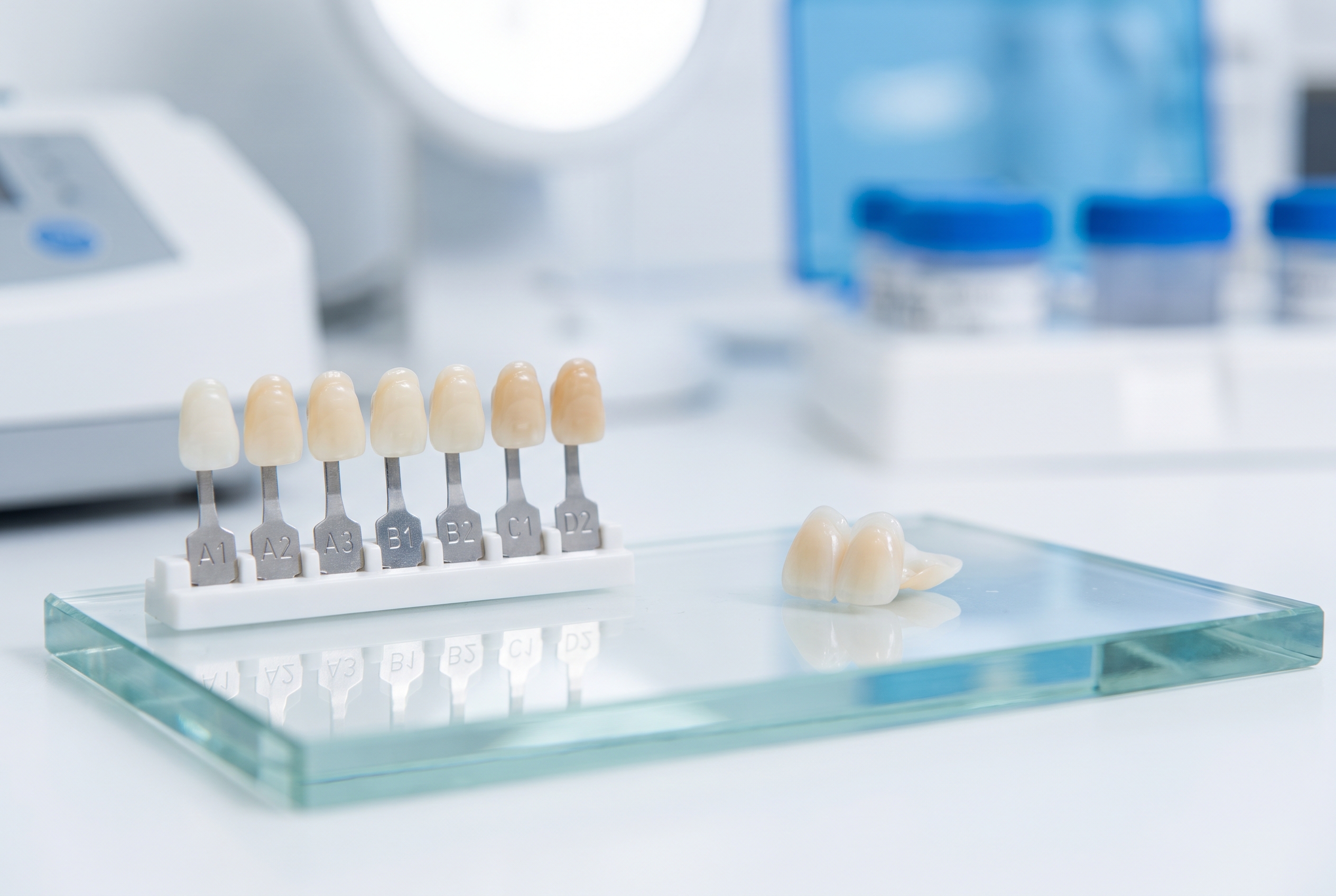
Most of what is written about composite veneers is aimed at patients and stops at the chairside direct technique. This guide is written for the practice deciding between direct, indirect composite, and porcelain, and it sits alongside our veneer lab service.
What a Composite Veneer Actually Is
A composite veneer is a thin layer of tooth-coloured resin composite bonded to the labial surface of a tooth to change its shape, shade, or position. The same material can be sculpted freehand at the chair or built on a model and sent back to you as a finished restoration. The first route is direct, the second is indirect.
- Material: a filled resin composite, the same chemistry family as a direct restorative material, layered and light cured.
- Coverage: labial surface, sometimes wrapping the incisal edge, rather than a full circumferential preparation.
- Bond: retained by adhesion to enamel and dentine, not by macro-mechanical preparation.
For a like-for-like comparison of the same situation handled in porcelain laminate, see our labial veneers lab guide.
Direct vs Indirect Composite Veneers
The decision that the consumer-facing pages skip is direct versus indirect. Both use composite, but the workflow, the control, and the lab involvement are different.
- Direct: the resin is placed and shaped by you at the chair, cured tooth by tooth, then finished and polished in a single visit. No lab, no impression, full artistic control in the mouth.
- Indirect: you take an impression or scan, we build the veneers on the model under controlled conditions, then return them for adhesive cementation. Better polymerisation, tighter contacts, and a more even emergence profile than freehand work.
Direct suits one or two teeth, additive cases, and situations where you want to test a shape before committing. Indirect suits multi-unit cases where consistency across the arch and chairside time matter more than same-day delivery.
When Indirect Composite Is the Right Call
Indirect composite is worth specifying when freehand layering across several units becomes hard to keep symmetrical, or when the patient wants a reversible, repairable result without the cost step up to porcelain.
- Multi-unit aesthetic cases: six or more anterior units where line angle and contour symmetry are difficult to control by hand in one sitting.
- Younger patients: where keeping the option open to revise or replace later, without porcelain commitment, is clinically sensible.
- Budget-led plans: where the patient wants more than direct freehand but is not ready for a porcelain case.
- Cases where you want the bench, not the chair, to carry the time cost of building and characterising each unit.
If the case really calls for the strength and stain resistance of ceramic, the honest answer is porcelain. We say so in the comparison below.
Composite vs Porcelain Veneers
Composite versus porcelain is the comparison patients ask about most, so it is worth being precise for the practice. The two materials behave differently in the mouth and over time.
- Durability: composite veneers commonly serve around 5 to 7 years, while well made porcelain often runs well beyond a decade. Composite wears and can chip at the incisal edge under heavy function.
- Staining: composite picks up stain at the margins and surface over time. Porcelain holds colour far better.
- Repairability: composite is the clear winner here. A chip can usually be added to and re-polished without remaking the unit. Porcelain failures generally mean a remake.
- Prep: both can be additive or minimal, but porcelain pressed work usually wants a defined, even reduction to carry the ceramic.
A useful framing for the patient conversation: composite is the lower cost, more reversible, more repairable option that asks for more maintenance, and porcelain is the longer lasting, more stain resistant option at a higher commitment. Neither is simply better.
Composite Veneer Kits and Material Choice
Search interest around a composite veneers kit usually means one of two things: a chairside layering system for direct work, or a guided system that uses a stent. For indirect cases the material choice sits with the lab, and it matters.
- Direct kits: shade-matched microhybrid or nanohybrid systems with enamel and dentine masses let you layer value and translucency by hand. Quality of result tracks operator skill closely.
- Guided systems: a preformed or lab-made stent indexes the composite, which improves repeatability across units but still relies on chairside finishing.
- Indirect material: lab composites are denser and more thoroughly cured than chairside-cured resin, which helps wear resistance and polish retention. This is the practical reason indirect composite often outperforms freehand direct on longevity.
Tell us the system and shade you work to and we will match the indirect build to it so the result reads consistently in the mouth.
Preparation and Bonding
Composite veneers live or die on the bond. Because retention is adhesive rather than mechanical, isolation and surface conditioning carry the case more than any preparation geometry.
- Preparation: many composite cases are additive or minimal prep, keeping enamel for the strongest bond. Reduce only where overcontour or shade would otherwise force it.
- Isolation: a dry field is non-negotiable for both direct layering and indirect cementation. Contamination at try-in is the most common reason a sound veneer fails early.
- Cementation: indirect composite veneers are seated with an adhesive resin protocol, the fitting surface prepared per the lab material so the cement bonds to both substrate and restoration.
For the broader prep philosophy on keeping enamel, see our minimal-prep veneers guide.
Durability, Wear, and Maintenance
Setting the right expectation up front protects the relationship with the patient. Composite is a maintenance material, not a fit and forget one, and the practice owns that message.
- Lifespan: plan for roughly 5 to 7 years of good service from a well made composite veneer, longer with disciplined maintenance and shorter under heavy parafunction.
- Wear points: incisal edges and high contact areas wear first. A nightguard is sensible where bruxism is present.
- Maintenance: periodic re-polishing restores surface lustre and removes early stain, which is part of the value of choosing composite over porcelain.
Composite does not directly cause decay, but a poorly adapted margin or a lapse in oral hygiene can let caries start at the edge. Margin quality, whether direct or indirect, is the controllable factor.
Sending an Indirect Composite Case to Flora
For indirect composite veneers we work from your scan or impression and your shade information. We accept files from 3Shape, Medit, iTero, and Dexis, and we are a DAMAS, DLA, and GDC accredited UK lab serving UK practices.
- Send us: the scan or impression, the working shade and any stump shade, and a note of the planned shape change or a reference image.
- We return: the indirect composite veneers built on the model, characterised and polished, ready for adhesive cementation.
- Turnaround: crown and bridge work runs to around 10 working days, and indirect composite sits in that frame depending on unit count.
If you have not used us for veneer work before, your first case is free, up to GBP 100, with no invoice and no contract. Send one case, judge the fit and the finish, then decide. The same offer applies across our e.max crown and veneer work.
How long do composite veneers last?
A well made composite veneer commonly serves around 5 to 7 years, longer with good maintenance and re-polishing, and shorter under heavy parafunction. Indirect lab-made composite tends to wear better than freehand direct because it is more thoroughly cured.
What is the difference between direct and indirect composite veneers?
Direct composite is layered and shaped at the chair in a single visit with full control in the mouth. Indirect composite is built by the lab on a model from your scan or impression, then returned for adhesive cementation, giving better polymerisation and more consistent contours across multiple units.
Are composite veneers good or bad?
Neither, it depends on the case. Composite is lower cost, more reversible, and easily repairable, but it wears and stains more than porcelain and needs maintenance. It is a strong choice for additive, budget-led, or younger-patient cases and a poor one where the patient wants a fit and forget result.
Composite vs porcelain veneers, which should I specify?
Choose composite when reversibility, repairability, and cost lead the plan, and porcelain when longevity and stain resistance lead it. Composite typically lasts about 5 to 7 years and is repairable chairside, while porcelain usually runs well beyond a decade but a failure means a remake. our e.max guide
Do teeth decay under composite veneers?
Composite veneers do not directly cause decay, but caries can start at a poorly adapted margin or where oral hygiene slips. Margin quality and patient maintenance are the controllable factors, whether the veneer is placed directly or fabricated indirectly.
Can Flora make indirect composite veneers from a scan?
Yes. Send us a scan or impression with your shade information and we build the veneers on the model for adhesive cementation. We accept 3Shape, Medit, iTero, and Dexis files, and your first case is free up to GBP 100 with no invoice or contract. labial veneers lab guide