.svg)
e.max Crowns: A Lab Guide for Dentists
e.max is the most reflexively prescribed aesthetic material in UK restorative dentistry and one of the most frequently misapplied. When an e.max case disappoints, the cause is almost never the ceramic. It is case selection (a molar bridge that should have been zirconia), preparation (1.5 mm of planned reduction that was 0.8 mm at the chair), shade communication (a translucent crown built over an unrecorded dark stump), or cementation (a thin restoration conventionally cemented when it needed an adhesive bond).
Want to learn more about our crown and bridge process at flora see our article.
Lithium disilicate is an outstanding material inside its envelope and an unreliable one outside it. This guide sets out where that envelope sits — when e.max is the right call and when it is not how we fabricate it at Flora, and what your preparation, shade record and cementation need to deliver for the restoration to perform as intended.
What e.max Actually Is
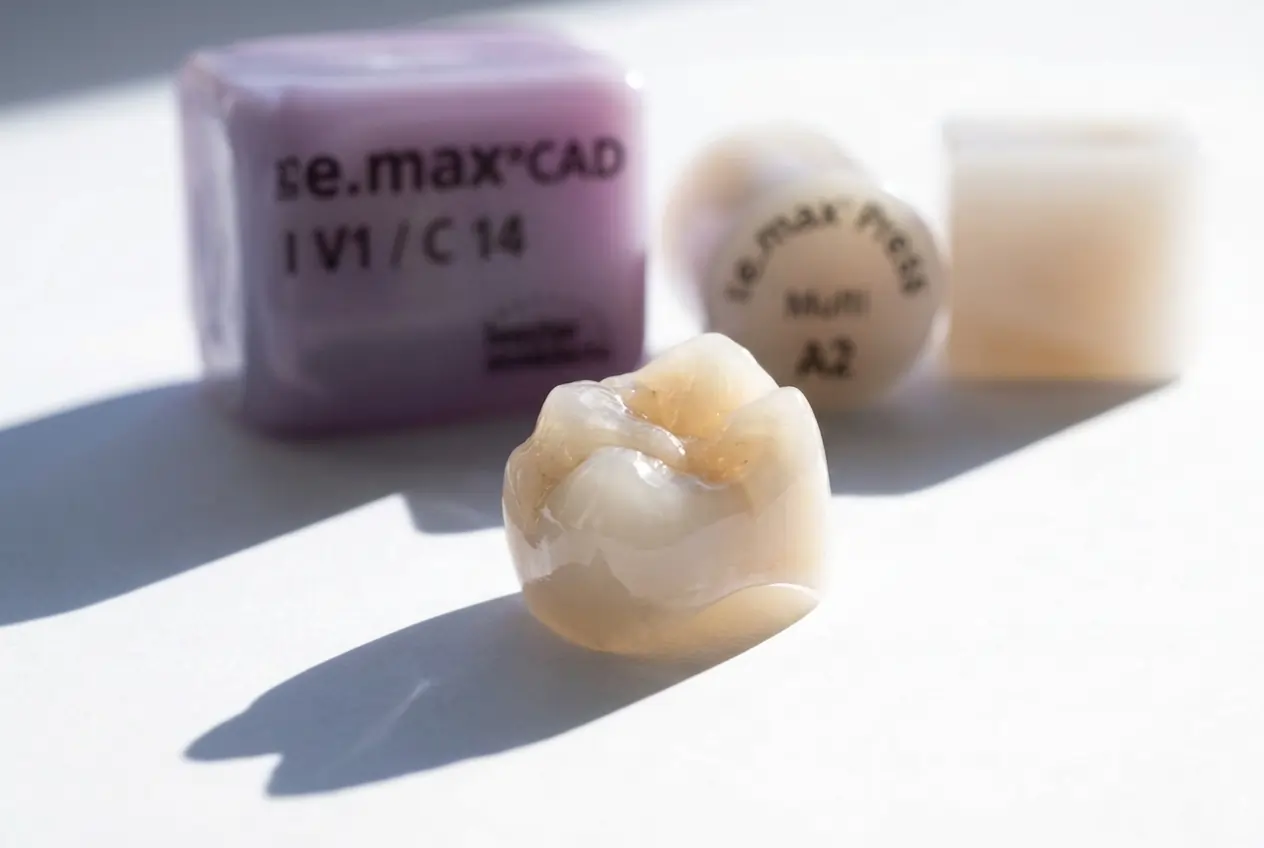
IPS e.max is a lithium disilicate glass-ceramic developed by Ivoclar. Its appeal is a combination most ceramics cannot offer simultaneously: genuinely enamel-like translucency with enough strength for most single-unit applications.
- Material: lithium disilicate glass-ceramic, metal-free
- Flexural strength: approximately 360–500 MPa (milled e.max CAD ~360–400 MPa; pressed e.max ~470–500 MPa) — far stronger than feldspathic porcelain, and well below monolithic zirconia (1,000 MPa and above)
- Optical behaviour: high translucency that transmits light like natural enamel, which is exactly why the underlying preparation colour matters so much
That last point is the one most often underestimated. e.max's beauty and its main clinical demand are the same property: because light passes through it, the restoration shows what is underneath. A flawless crown over an unrecorded dark stump will read grey, and that is a communication failure, not a fabrication one.
How the Lab Makes an e.max Crown
There are two fabrication routes, and the distinction occasionally matters for your case.
e.max Press (hot-pressing / lost-wax). The restoration is waxed up — by hand or digitally — invested, and a lithium disilicate ingot is pressed into the mould under heat and pressure. Pressing yields excellent marginal accuracy and slightly higher strength, and is often preferred for thin restorations and veneers where fit and edge strength are critical.
e.max CAD (milling). The crown is milled from a pre-crystallised "blue" block, then fired in a ceramic furnace. Crystallisation during that firing converts it to its final shade and full strength. Milling is efficient and highly accurate for single units in a digital workflow.
Either route can be finished two ways:
- Monolithic (full contour): pressed or milled in one piece and characterised with surface stains and glaze. This keeps maximum strength and is the right choice for most posterior single crowns.
- Cut-back and layered: a core is cut back on the facial aspect and hand-layered with fluorapatite ceramic (e.max Ceram) to build incisal translucency and internal characterisation. This is where anterior cases earn their aesthetics — and where complete shade and photographic communication pays off most.
When e.max Is the Right Choice and When It Isn't
The single most useful thing a lab can tell a dentist about e.max is where its limits are. Prescribing inside this envelope is what makes the material reliable.
If a case sits in the right-hand column, the honest recommendation is usually monolithic zirconia or, for non-visible posterior longevity, gold. We would rather have that conversation before fabrication than after a fractured connector.
e.max vs Zirconia Choosing Between Them
This is the most common material decision in crown and bridge work, and it comes down to where the case sits on the strength–aesthetics axis.
A practical rule: if the case is visible and the demand is aesthetics, e.max; if the case is load-bearing, posterior, long-span, or the patient is a bruxer, zirconia. For the strength side of this decision, see our zirconia guide.
Preparation Guidelines for e.max
e.max performs to specification only when the preparation gives it the thickness it needs. Under-reduction is the most common reason a technically sound crown comes back over-contoured or fails early. Requirements differ by restoration type.
Across every restoration type, three principles hold:
- Margins: a clear shoulder or chamfer, never a feather edge — e.max needs bulk at the margin to resist fracture
- Line angles: all internal line angles rounded; sharp angles concentrate stress and become fracture origins
- Anatomic reduction: follow cusp and incisal morphology, not a flat table
If the available space genuinely will not reach these minimums a short clinical crown, a heavily worn dentition — that is a signal to reconsider the material before the impression, not after the remake.
Shade and Stump Shade Why e.max Needs Both
Because e.max transmits light, the colour of the preparation directly affects the final result. A single body shade is not enough information for a translucent material.
What a complete e.max shade prescription includes:
- Body, cervical and incisal shades as separate values
- Stump shade — the colour of the prepared tooth, recorded against the Ivoclar Natural Die (ND) guide — so the technician selects the correct ingot opacity
- Clinical photography with the shade tab in frame, for any visible unit
The ingot opacity is chosen from the stump shade:
- HT (High Translucency): veneers, inlays, onlays over a sound, well-coloured substrate
- MT / LT (Medium / Low Translucency): standard and full-coverage crowns
- MO / HO (Medium / High Opacity): dark, root-filled or post-and-core preparations that must be masked
Get the stump shade wrong or omit it and an otherwise perfect anterior crown can read flat or grey. This is the single highest-leverage habit in e.max work; our shade-taking guide for dental restorations sets out the full protocol.
Cementation and Bonding Protocol
e.max is an etchable glass-ceramic, which means it can be adhesively bonded — and for many cases, it must be.
Adhesive bonding (preferred for most cases, mandatory for thin units and veneers):
- Hydrofluoric acid etch of the fitting surface (5% HF, ~20 seconds), then rinse and dry
- Apply silane coupling agent and let it react
- Bond with an adhesive resin cement, following manufacturer steps for isolation and curing
Conventional cementation (RMGI) is only appropriate for full-coverage crowns with a retentive preparation and adequate material thickness (≥1.5 mm). It is not appropriate for veneers, inlays, onlays or thin restorations, where bond strength is doing the structural work. When in doubt, bond.
Sending an e.max Case to Flora
To return an e.max restoration you can seat at the first appointment, we need:
- Preparation scan or definitive PVS/polyether impression, opposing arch, and bite record
- Body, cervical and incisal shades with a stump shade for every case
- Clinical photography with a shade tab for any visible unit
- Confirmation of cementation intent (bond vs conventional) if it affects the design
We fabricate e.max by press or CAD depending on the case, monolithic or layered depending on the aesthetic demand, and we will flag any case where the indication, reduction or shade information suggests a different material or a conversation before fabrication.
Frequently Asked Questions
Our team answer to your questions
An e.max crown is made of lithium disilicate glass-ceramic, a metal-free material developed by Ivoclar with a flexural strength of approximately 360–500 MPa. It combines enamel-like translucency with enough strength for most single-unit restorations, which is why it is widely used for anterior crowns and veneers.
e.max is not suitable for bridges longer than three units, molar-terminal bridges, cantilever or Maryland bridges, or patients with severe bruxism — its strength sits well below zirconia. Because it is translucent, it also depends on an accurate stump shade to avoid greyness over dark preparations, and thin restorations must be adhesively bonded rather than conventionally cemented.
Neither is universally better; they serve different cases. e.max is the stronger aesthetic choice for visible anterior crowns, veneers, inlays and onlays. Monolithic zirconia is the better choice for posterior load, molar and long-span bridges, bruxers and implant work, where its 1,000+ MPa strength matters more than maximum translucency.
By the way we made a full article e.max vs zirconia
A minimum of 1.5 mm anatomic occlusal/incisal reduction and 1.0 mm circumferential reduction finished as a shoulder or heavy chamfer, with all internal line angles rounded. Feather-edge margins are contraindicated. If the case cannot accommodate 1.5 mm occlusal reduction, an alternative material should be considered before the impression.
e.max is adhesively bonded for most cases: etch the fitting surface with hydrofluoric acid, apply a silane coupling agent, and bond with an adhesive resin cement. Conventional cementation is only acceptable for full-coverage crowns with a retentive preparation and adequate thickness; veneers, inlays, onlays and thin restorations must be bonded.
Because e.max is translucent, the colour of the prepared tooth shows through the restoration. The stump shade — recorded against the Ivoclar Natural Die guide — tells the technician which ingot opacity to use, from high translucency over a sound substrate to high opacity to mask a dark or post-and-core preparation. Without it, the final shade is unpredictable.