.svg)
Dental Bridges: Types, Design and Prescription A Lab Guide for Dentists
Most bridge failures are design failures, not fabrication failures. A connector sized under the fracture threshold, a Maryland wing asked to do a conventional bridge's job, a cantilever hung off the wrong abutment, a pontic form the patient cannot clean by the time any of these reaches the laboratory bench, the outcome is already decided. The prescription is where a bridge succeeds.
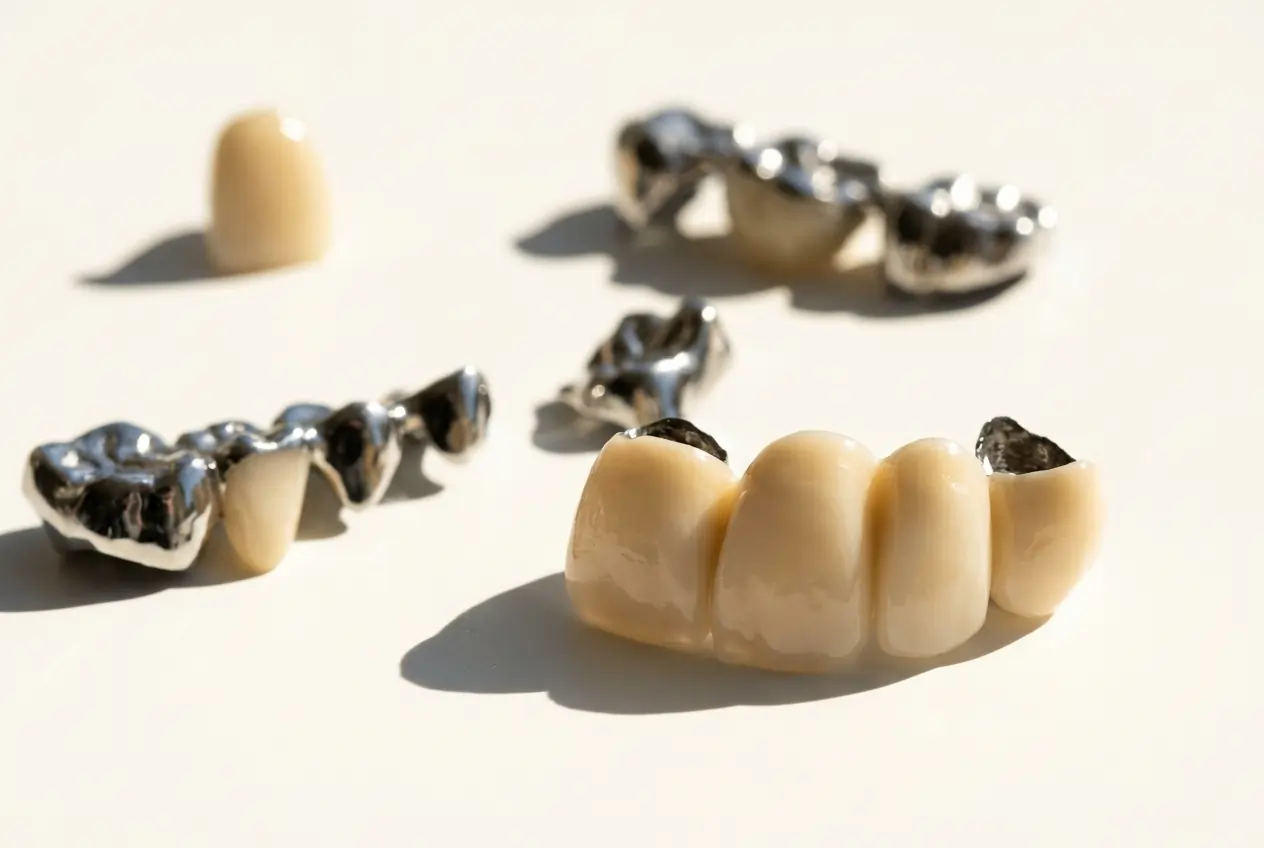
Want to learn how we process crown and bridges at Flora check our article.
This guide covers the four bridge types and when each is the right answer, the design decisions a prescription needs to settle — pontic form, connectors, span and material — and the honest comparison dentists actually face in treatment planning: bridge, partial denture, or implant
The Four Bridge Types and When Each Works
The Maryland Bridge Deserves a Better Reputation
Some commentary asks whether dentistry should "move on" from the resin-bonded bridge. The UK evidence points the other way — used inside its indication, the modern RBB is one of the most conservative, highest-value restorations available:
- Modern design is a single-wing cantilever, not the original two-wing form. Two rigid wings on teeth that flex independently is how debonds happen; current UK teaching favours one wing, one abutment.
- It is enamel-borne, so the abutment needs sound enamel and the bond needs proper isolation. That is the deal: minimal destruction in exchange for adhesive discipline.
- The classic case is the missing lateral incisor — especially in younger patients where an implant must wait for skeletal maturity. A well-made RBB buys years, reversibly.
- Material note: the wing is metal (with an opaque cement to manage shine-through) or zirconia. e.max is contraindicated for Maryland designs — as is any long span. Our e.max guide covers its bridge limits.
The honest limits: it is a single-tooth solution, it does not like heavy guidance on the pontic, and case selection does the heavy lifting. Prescribed inside that envelope, debond rates are low and the tooth-cost is nearly zero.
Cantilevers Useful, Within One Rule
A cantilever bridge works when the lever is short and the load is light. One pontic, one sound abutment, no molars hanging off premolars. The further the pontic sits from the abutment's axis, the more the case becomes an exercise in torque on a periodontal ligament that never agreed to it.
Bridge Design What the Prescription Must Settle
A prescription that says "3-unit zirconia bridge" has chosen a span and a material. The design is still undecided, and design is what fails. Four decisions to write down:
1. Pontic form. Modified ridge lap is the posterior default cleanable, reasonable aesthetics. Ovate gives the best emergence aesthetics but requires a prepared tissue site. Sanitary (hygienic) maximises cleansability in non-visible posterior positions. These are not interchangeable, and if the docket doesn't specify, the lab defaults which may not match your intent.
2. Connector dimensions. Connectors carry the whole span. Below minimum cross-section they fracture — these are physics thresholds, not preferences: typically 9 mm² for posterior zirconia, 16 mm² for e.max. Tight aesthetic spaces (a lower incisor bridge, a short clinical crown) can make an adequate connector impossible in ceramic — better to know before fabrication.
3. Span and material together. The rules from our material guides apply with no exceptions for optimism: e.max maximum 3 units, terminal abutment no further than the second premolar, never cantilevered, never Maryland. 3Y zirconia handles long spans up to full-arch. Metal (full-cast or PFM) remains the fallback for spans and occlusions that punish ceramic — see the metal crowns guide. High-translucency 5Y zirconia is a single-unit aesthetic material, not a bridge framework.
4. Abutment reality. Retainer crowns obey the same preparation minimums as single crowns (e.max / zirconia) — plus one bridge-specific demand: a shared path of insertion across all abutments. Divergent preparations that each work alone can be impossible to seat as a unit.
Want to know more about zirconia vs e.max review or article here.
Bridge, Partial Denture or Implant the Real Prescribing Question
"Bridges and partials" get searched together because they answer the same clinical question — replace missing teeth — from opposite directions: fixed versus removable. The honest decision map:
The pattern in practice: heavily restored abutments either side of a short gap → bridge (the preparations cost little because the teeth are already restored). Sound, unrestored abutments → implant (don't spend two healthy teeth on one gap) — or an RBB where an implant must wait. Multiple gaps or free-end saddles → partial denture or implant work. A laboratory that makes all three has no reason to steer you anywhere but the indication.
Sending a Bridge Case to Flora
A bridge docket that prevents the fit-appointment conversation contains:
- Abutment teeth and pontic position(s); material and type (conventional / Maryland / cantilever)
- Pontic form or the aesthetic/hygiene priority so we can propose one
- Working impression or scan of both abutments and the full pontic space, opposing arch, bite record
- Shade with photography for any visible unit (shade guide)
- For RBBs: which abutment carries the wing, and the enamel situation
Bridge work runs on our planned ten-working-day schedule, by GDC-registered technicians in a DAMAS- and DLA-registered UK laboratory. Where a span, connector or material combination sits outside the thresholds above, we flag it before fabrication — a design conversation costs ten minutes; a fractured connector costs the case.
Frequently Asked Questions
Our team answer to your questions

Four: conventional fixed bridges (retainer crowns on both abutments — the workhorse), Maryland or resin-bonded bridges (a wing bonded to enamel, minimal preparation, ideal single anterior), cantilever bridges (supported from one abutment, short light-load spans), and implant-supported bridges (for longer spans or to spare sound teeth).
Yes — inside their indication. The modern single-wing (cantilever) resin-bonded design has low debond rates on sound enamel and is one of the most conservative restorations available, classically for a missing lateral incisor or to bridge the years before an implant in a young patient. They are not for posterior load, long spans or heavy parafunction.
A bridge suits a short gap with abutments that are already restored — it is fixed and feels like teeth, but it spends abutment tissue. A partial denture suits multiple gaps and free-end saddles, needs minimal preparation and no surgery, but is removable. Sound abutments either side of a single gap usually argue for an implant (or a resin-bonded bridge) rather than cutting two healthy teeth.
Three honest reasons: the abutments are sound and a conventional bridge would destroy healthy tooth tissue; the abutments are compromised and cannot carry the load; or the span/material combination sits outside fracture thresholds. Hygiene matters too — a bridge needs a cleanable pontic design and a patient who will use a threader or interdental brushes.
It is fixed — cemented or bonded in place, not removable by the patient — but not literally permanent. Well-designed bridges routinely serve 10–15 years and often longer; longevity tracks design quality (connectors, span, material), abutment health and hygiene more than anything else.
At Flora Dental Lab, bridge and crown work runs to a planned ten-working-day schedule, agreed when the case is logged. We use that time to check the design connectors, span, path of insertion, pontic form before fabrication, because a bridge that seats at the first appointment is faster than a quick one that comes back.